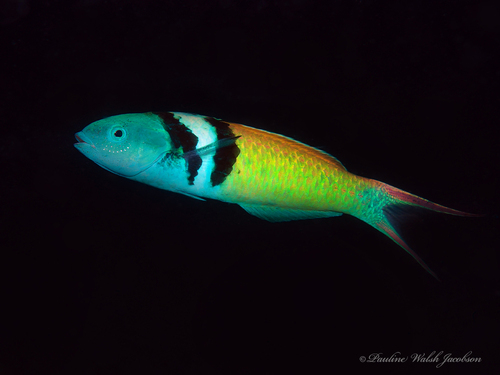
Caribbean Bluehead Wrasse
Thalassoma bifasciatum
Meet the vibrant 'cleaner' of the Caribbean. The Bluehead Wrasse is a master of transformation and a burst of electric color on the tropical reef.
Quick Identification
Size
3 to 6 inches (7.5 to 15 cm) in length; weight is generally less than 2 ounces (50 grams).
Colors
Terminal males feature a brilliant blue head, followed by two black vertical bars sandwiching a white band, with a green or blue-green body. Initial phase individuals (females and young males) are typically bright yellow or white with a dark mid-lateral stripe.
Key Features
- Distinct bright blue head in terminal males
- Two dark vertical bars behind the head
- Torpedo-shaped, sleek body
- Initial phase is bright yellow with a dark stripe along the side
When You’ll See Them
Loading activity data...
Behavior
The Bluehead Wrasse is one of the most active and conspicuous residents of the Caribbean reef. These fish are famous for their complex social structures and protogynous hermaphroditism, meaning females can transform into terminal-phase males when the dominant male in a territory disappears. They are highly energetic swimmers, constantly darting through the water column or over the reef surface in search of food.
Beyond their social dynamics, they play a vital role as 'cleaner fish.' They establish cleaning stations where larger fish—ranging from snappers to groupers—visit to have parasites and dead skin removed. This interaction is a fascinating display of marine cooperation, as the wrasse gains a meal while the 'client' fish receives a health check-up. They are generally bold and unafraid of divers or underwater cameras, often approaching lenses out of curiosity.
EverydayEarth exclusive
Camera Tips
To capture the high-energy movement of the Bluehead Wrasse, you need an underwater camera setup capable of high frame rates. Set your AI-powered camera or action cam to at least 60fps (120fps is even better for slow-motion playback) to catch their quick, darting turns. Because these fish are most common in shallow water, utilize the natural sunlight of the 'Golden Hours' underwater (mid-day). If you are deeper than 10 feet, use a red filter to restore the warm tones that are absorbed by the water column, ensuring the terminal male's blue head doesn't look washed out.
For the best results, place your camera housing near a prominent coral head or a known 'cleaning station.' Look for areas where larger fish seem to be hovering or posing unnaturally; this is where the wrasse will be most active. Use a weighted tripod or a sand-screw mount to keep the camera steady against the surge. Since Bluehead Wrasse are naturally curious, they will often swim right up to the lens port. Avoid using heavy artificial lights which might spook the 'client' fish, but a small, diffused fill light can help pop the iridescent greens of the wrasse’s body.
If you are struggling to get them in frame, you can gently disturb a small patch of sand or turn over a loose rock (where permitted and environmentally safe). The wrasses will rush in immediately to inspect the area for stirred-up invertebrates. Ensure your camera is set to a wide-angle FOV (Field of View) because these fish move so fast that a narrow crop will likely miss the action. Finally, check your housing seals meticulously; the Caribbean salt water is unforgiving to electronics.
Similar Species
Species that look similar or are commonly confused with Caribbean Bluehead Wrasse.
Yellowhead Wrasse
The Yellowhead Wrasse lacks the bold black-and-white vertical bars and has a bright yellow head that fades into a dark purple or blue body.
Slippery Dick
A cousin in the wrasse family, this fish is typically paler with a dark spot on the dorsal fin and lacks the electric blue head of the terminal male Bluehead.
Frequently Asked Questions
Record Caribbean Bluehead Wrasse at your habitat
Connect a camera to start building your own species record — AI identifies every visitor automatically.