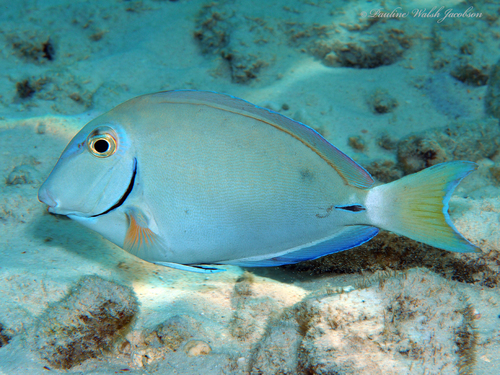
Caribbean Ocean Surgeonfish
Acanthurus tractus
The Caribbean Ocean Surgeonfish is the tireless gardener of the Atlantic reefs, constantly grazing on algae with its specialized 'lawnmower' mouth. Easily identified by the sharp defensive spine at its tail, this sleek grazer is a must-see for any coastal backyard explorer.
Quick Identification
Size
Typically 15 to 38 cm (6 to 15 inches) in length
Colors
Body ranges from yellowish-brown to grayish-blue with fine, wavy horizontal lines; yellowish tint on the pectoral fins and tail; blue markings around the eyes.
Key Features
- Sharp, retractable spine at the base of the tail (caudal peduncle)
- Crescent-shaped tail with a pale or white trailing edge
- Thin, dark horizontal lines across the body
- Distinctive blue or white ring around the eyes
When You’ll See Them
Geographic range
Where Does the Caribbean Ocean Surgeonfish Live?
Native to the tropical and subtropical waters of the Western Atlantic Ocean, the Caribbean Ocean Surgeonfish is a staple of the Caribbean Sea and the Gulf of Mexico. Its range extends from the warm coastal waters of Florida and the Bahamas southward to the northern coast of South America, including the shores of Central American countries like Belize and Mexico. While they are most concentrated in coral-rich environments, they are also frequently spotted in the rocky shallows of the Florida Keys and throughout the Greater and Lesser Antilles.
Basemap © OpenStreetMap contributors
Behavior
The Caribbean Ocean Surgeonfish is a busy, diurnal grazer that plays a vital role in maintaining the health of coral reefs. Named for the scalpel-like spine located at the base of their tail, these fish are generally peaceful toward other species but can be territorial with other surgeonfish. They are often seen in small schools or large multi-species groups, frequently mixing with Blue Tangs to overwhelm the defenses of territorial damselfish and gain access to prime grazing spots.
During the day, they are constant feeders, moving methodically across rocky substrates and reef flats. Their social structure is fluid; while they may forage in large aggregations to minimize predation risk, they are also comfortable as solitary individuals. When threatened, they flip their tail to brandish their sharp spine, though they generally prefer to retreat into the crevices of the reef. In areas with high human activity, such as public piers or popular snorkeling beaches, they can become quite bold, though they should never be touched due to their defensive spines.
EverydayEarth exclusive
Camera Tips
Capturing the Caribbean Ocean Surgeonfish requires an underwater camera setup, such as a GoPro or a specialized reef-cam housing. If you live on a coastal property with a dock or sea wall, you can mount your camera to a submerged piling or a weighted tripod placed in the shallow flats. Position the lens to face a patch of sunlit, algae-covered rock, as this is where the surgeonfish will spend the majority of its time grazing. Using a wide-angle lens is essential to capture the movement of schools as they sweep across the substrate.
Lighting is the biggest challenge when filming underwater. For the best color reproduction, record during the middle of the day (10 AM to 2 PM) when the sun is directly overhead, providing maximum penetration through the water column. If you are filming in water deeper than 10 feet, consider using a red filter to compensate for the loss of red light, which will prevent your footage from looking overly green or blue. This will help the subtle blue rings around the fish's eyes and the yellow in its fins pop on screen.
To attract these fish to your camera’s field of view without using artificial bait, look for areas with 'turf algae'—short, fuzzy green or brown growth on rocks. Because surgeonfish are naturally curious and constantly searching for food, they will naturally congregate in these areas. Ensure your camera is set to a high frame rate (60fps or higher) to capture their quick, darting swimming motions and the occasional flick of their tail spine. If your camera has an AI-detection feature, set the sensitivity high, as their constant grazing motion can sometimes be subtle against a busy reef background.
Similar Species
Species that look similar or are commonly confused with Caribbean Ocean Surgeonfish.
Frequently Asked Questions
Record Caribbean Ocean Surgeonfish at your habitat
Connect a camera to start building your own species record — AI identifies every visitor automatically.