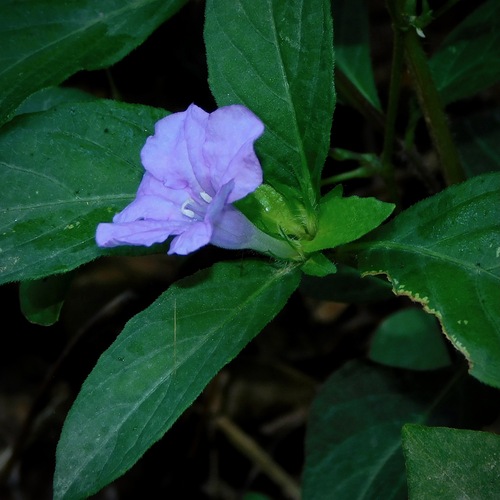
Carolina ruellia
Ruellia caroliniensis
A delicate lavender treasure of the American South, the Carolina ruellia transforms shaded garden corners into bustling hubs for butterflies and native bees.
Quick Identification
Size
Stands 30–90 cm (1–3 feet) tall with a spread of 30–60 cm (1–2 feet)
Colors
Pale lavender to violet-blue flowers; deep green foliage; stems often have fine white hairs
Key Features
- Trumpet-shaped flowers with five rounded lobes
- Opposite, ovate leaves with hairy margins
- Square-ish stems typical of the Acanthus family
- Flowers emerge from the leaf axils rather than the tips
When You’ll See Them
Geographic range
Where Does the Carolina ruellia Live?
Native to the North American continent, the Carolina ruellia is a quintessential wildflower of the southeastern United States. Its natural range extends from the sandy pine barrens of New Jersey and Pennsylvania southward through the Florida peninsula, reaching as far west as Texas, Oklahoma, and Missouri. It is most frequently encountered in the humid subtropical regions of the Deep South, where it thrives in both untouched wilderness and disturbed roadside habitats.
Basemap © OpenStreetMap contributors
Behavior
Carolina ruellia is a resilient perennial wildflower that serves as a vital component of the southeastern ecosystem. Unlike aggressive garden varieties, this native species grows in tidy clumps and spreads through a fascinating mechanism known as explosive dehiscence. When its seed pods dry out, they burst with enough force to fling seeds several feet away, allowing the plant to gradually colonize suitable nearby patches of soil.
The plant follows a strictly diurnal rhythm. Each individual blossom typically opens at dawn and remains vibrant for only a single day, usually dropping off by late afternoon or early evening. This fast-paced blooming cycle ensures a constant rotation of fresh nectar for pollinators, making the plant a high-traffic hub for bees, butterflies, and hummingbirds during the peak of summer.
EverydayEarth exclusive
Camera Tips
To capture the best images of Carolina ruellia, positioning is everything. Place your camera on a low tripod or a ground mount, aiming for a lens height of about 12 inches. This 'bug's-eye view' allows you to look directly into the trumpet-shaped blooms and better see the visiting pollinators. Because the flowers are delicate and sit on relatively thin stems, choose a location sheltered from the wind to prevent motion blur, or use a faster shutter speed (at least 1/500s) if your camera settings allow.
Timing is the second most critical factor. Since these flowers typically fall off by the evening, set your AI-powered camera to its most active 'capture mode' during the early morning hours. The light between 7:00 AM and 10:00 AM provides the softest illumination for the pale lavender petals and is also the peak foraging time for the bees and butterflies that visit the plant. In a backyard setting, ensuring the plant is well-watered the evening before will help the blooms look turgid and vibrant for their morning debut.
If you are using a trail camera to monitor wildlife interactions, focus on a large cluster of plants rather than a single flower. This increases the probability of capturing the Common Buckeye butterfly, which uses Carolina ruellia as a primary host plant. For those interested in botanical details, a camera with a good macro or close-focusing capability is ideal to highlight the fine, silvery hairs (trichomes) on the stems, which are a key identification feature of the species.
Frequently Asked Questions
Record Carolina ruellia at your habitat
Connect a camera to start building your own species record — AI identifies every visitor automatically.