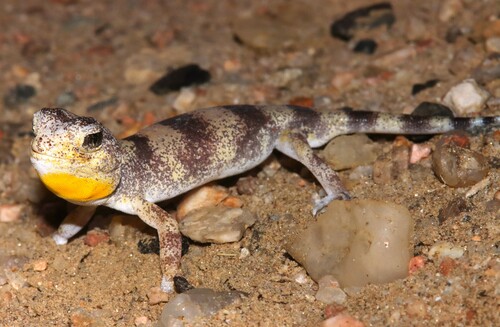
Carp's Barking Gecko
Ptenopus carpi
The vocal heartbeat of the Namib Desert, Carp's Barking Gecko is a tiny architect of the gravel plains known for its rhythmic sunset serenades.
Quick Identification
Size
Snout-to-vent length of 50-65 mm (2.0-2.5 inches); total length including tail up to 100 mm (4 inches)
Colors
Pale sandy yellow to buff with dark brown or greyish reticulated markings; belly is uniformly white or cream
Key Features
- Extraordinarily large eyes with vertical pupils
- Blunt, oversized head distinct from the neck
- Velvety texture due to fine granular scales
- Slender toes lacking the adhesive pads found in other geckos
When You’ll See Them
Geographic range
Where Does the Carp's Barking Gecko Live?
This resilient reptile is a native of the African continent, found exclusively within the borders of Namibia. It is an endemic species of the Namib Desert, where its core population is concentrated on the gravel plains between the Kuiseb and Huab Rivers. Unlike more widespread lizards, its range is strictly tied to the unique geological features of the central Namib coast and its immediate hinterland.
Basemap © OpenStreetMap contributors
Behavior
Carp's Barking Gecko is a nocturnal specialist of the desert floor, known for its incredible engineering skills. Unlike many geckos that climb, this species is strictly terrestrial and excavates deep, winding burrows in the compacted gravel plains. These tunnels provide a vital sanctuary from the extreme temperature fluctuations of the Namib Desert, keeping the lizard cool during the day and warm at night.
The most famous behavior of this species is its vocalization. At dusk, males position themselves at the entrance of their burrows and produce a rhythmic series of 'clicks' or 'barks' to signal their territory and attract mates. They are highly territorial and will defend their burrow entrances against intruders with surprising vigor. When threatened, they can retreat into their tunnels with lightning speed, using their streamlined bodies to 'swim' through loose surface sand.
EverydayEarth exclusive
Camera Tips
To successfully capture Carp's Barking Gecko on camera, you must focus on their burrow entrances. Look for small, crescent-shaped holes in the hard-packed gravel; if you hear a clicking sound at sunset, you’ve found an active site. Place your camera on a low-profile ground mount or a partially buried brick, ensuring the lens is only 20-30 centimeters from the ground. Angle the camera slightly upward toward the burrow mouth to catch the male as he emerges to call.
Because these geckos are highly sensitive to light, use a camera equipped with 'No-Glow' black infrared LEDs. Standard red-glow LEDs or white flashes will often cause the gecko to retreat instantly. Set your camera to a high-sensitivity PIR (Passive Infrared) setting, but be mindful that blowing desert sand can cause false triggers. Using a 'time-lapse' mode at 1-minute intervals during the first two hours after sunset can be an effective backup strategy if the motion sensor fails to trip.
Video mode is highly recommended for this species. A 15-second clip will capture the fascinating throat movements and the 'barking' posture that photos miss. If you are in a particularly dry area, placing a very small, shallow bottle cap of water in front of the burrow can encourage the gecko to stay in the frame longer, though they get most of their moisture from their prey and the coastal fog.
Similar Species
Species that look similar or are commonly confused with Carp's Barking Gecko.
Frequently Asked Questions
Record Carp's Barking Gecko at your habitat
Connect a camera to start building your own species record — AI identifies every visitor automatically.