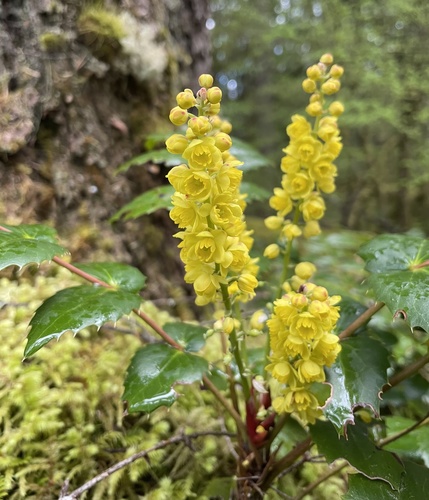
Cascade Oregon-grape
Berberis nervosa
A resilient evergreen gem of the Pacific Northwest, the Cascade Oregon-grape transforms shaded forest floors with golden blooms and dusty blue berries.
Quick Identification
Size
Height ranges from 10 to 60 cm (4 to 24 inches), with a spreading habit often reaching 60–100 cm (2–3 feet) in width.
Colors
Dull, matte olive-green leaves that often turn reddish or bronze in winter; bright canary-yellow flower spikes; dark dusty-blue berries with a waxy bloom.
Key Features
- Low-growing evergreen shrub with a matte leaf finish
- Compound leaves with 9–19 spine-toothed leaflets
- Central stem lacks the tall, woody branching of its relatives
- Flowers grow in long, upright clusters (racemes) at the ends of branches
When You’ll See Them
Geographic range
Where Does the Cascade Oregon-grape Live?
Native to the western regions of North America, the Cascade Oregon-grape is a quintessential plant of the Pacific Northwest. Its range extends from the southern tip of British Columbia down through the damp forests of Washington and Oregon, reaching as far south as the coastal mountain ranges of Northern California. It is most frequently encountered in the rain shadows and humid forests between the Pacific coast and the crest of the Cascade Mountains.
Basemap © OpenStreetMap contributors
Behavior
Cascade Oregon-grape is a resilient, slow-growing evergreen shrub that functions as a critical groundcover in the Pacific Northwest understory. Unlike many plants that compete for sunlight, this species has adapted to thrive in the deep shade of coniferous canopies. It spreads primarily through underground rhizomes, slowly forming dense colonies that provide excellent cover for ground-nesting birds and small mammals.
During the spring, the plant produces an abundance of nectar-rich yellow flowers that serve as an essential early-season food source for pollinators like orchard mason bees and bumblebees. In late summer, these flowers develop into tart, waxy blue berries. While the plant is stationary, its seasonal 'behavior'—the shifting of leaf color from green to deep burgundy in cold weather—makes it a dynamic visual element in backyard habitats and wild spaces alike.
EverydayEarth exclusive
Camera Tips
To capture the best wildlife activity on your Cascade Oregon-grape, place your camera at a very low angle, roughly 6–10 inches off the ground. Because this is a low-growing shrub, the most interesting action happens at ground level. During the spring bloom, use a camera with a high-speed trigger or a dedicated macro mode to capture the fast-moving hummingbirds and bees that visit the bright yellow flower racemes. Position the lens about 2 feet away from a healthy flower cluster for the best focus.
When the berries ripen in late summer, target the 'fruit thieves.' Spotted Towhees, Varied Thrushes, and American Robins are frequent visitors. Set your camera to 'Burst Mode' or a short 10-second video clip to catch the birds navigating the prickly leaves to reach the fruit. Since this plant thrives in the shade, you may need to manually increase your camera’s ISO or exposure compensation to avoid grainy images in the dim forest understory.
Don't ignore the winter months. The leaves of Cascade Oregon-grape turn a beautiful reddish-purple in the cold. A trail camera set to time-lapse mode can capture the stunning color transition over several weeks. If you are using a motion-activated camera, ensure it is shielded from the wind, as the stiff, leathery leaves can sometimes trigger 'false positives' if they move too aggressively in a breeze.
Frequently Asked Questions
Record Cascade Oregon-grape at your habitat
Connect a camera to start building your own species record — AI identifies every visitor automatically.