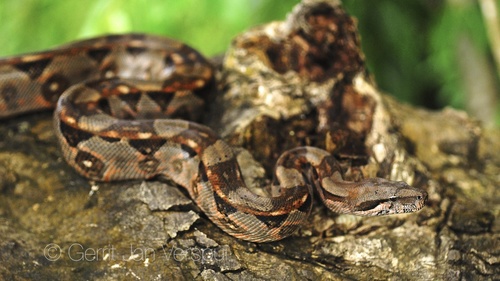
Central American Boa
Boa imperator
A master of camouflage and a gentle giant of the tropics, the Central American Boa is a fascinating constrictor commonly found in backyards from Mexico to Colombia.
Quick Identification
Size
Adults typically range from 1.3 to 2.5 metres (4 to 8 feet) in length and weigh between 6 and 15 kg (13 to 33 lbs), though females are significantly larger than males.
Colors
Tan, gray, or cream base with dark brown to black 'saddle' markings; the tail is often a brilliant reddish-brown or copper color.
Key Features
- Distinctive dark hourglass 'saddles' along the back
- Reddish-brown or burnt-orange tail markings
- Triangular head with a dark line through the eye and a center stripe on the crown
When You’ll See Them
Geographic range
Where Does the Central American Boa Live?
Native to the Americas, the Central American Boa occupies a vast territory stretching from the coastal lowlands of Mexico through the heart of Central America and into northwestern South America, specifically Colombia and Ecuador. While they are masters of the tropical landscape, they have also successfully established themselves in non-native regions like southern Florida and various Caribbean islands, where the warm, humid climate mimics their ancestral home.
Basemap © OpenStreetMap contributors
Behavior
The Central American Boa is a primarily solitary and nocturnal predator, though they are frequently seen basking in the sun during the cooler morning hours. While juveniles are highly arboreal, spending much of their time in the canopy to avoid predators, adults become more terrestrial as they grow heavier. They are classic ambush hunters, often remaining motionless for days in a well-chosen spot—such as a hollow log or a sturdy branch—waiting for prey to cross their path.
In terms of social interaction, these snakes are non-aggressive toward humans and generally prefer to retreat rather than confront. However, they will hiss loudly as a warning if they feel cornered. In suburban environments, they are often tolerated or even welcomed because they provide excellent natural pest control, keeping local rodent populations in check without the need for traps or chemicals.
EverydayEarth exclusive
Camera Tips
Capturing a Central American Boa on camera requires a different approach than filming mammals. Because snakes are ectothermic (cold-blooded), they may not always trigger a standard Passive Infrared (PIR) sensor if their body temperature matches the ambient environment. To increase your chances, set your camera to 'High' sensitivity or use a time-lapse mode that takes a photo every 1-5 minutes during the night. If your camera allows, use a 'Hybrid' mode that captures both a photo and a short video clip.
For placement, focus on 'travel corridors' such as the base of large trees, stone walls, or along the edges of dense brush. Since these snakes love to climb, try mounting one camera about 1.5 metres (5 feet) high, angled slightly downward toward a thick horizontal branch. On the ground, look for areas with leaf litter or fallen logs which provide natural cover for their ambush spots. If you have a water feature or a pond in your yard, this is a prime location as it attracts the rodents and birds the boa preys upon.
Lighting is crucial since they are most active after dark. Use a camera with a 'No-Glow' or 'Black' infrared flash to avoid startling the snake or drawing unwanted attention to the equipment. During the dry season, snakes are more mobile as they search for water and mates, making it the best time to see them on the move. Always ensure the camera has a clear line of sight, as even a single blade of grass moving in the wind can cause false triggers or obscure the snake's intricate saddle patterns.
Frequently Asked Questions
Record Central American Boa at your habitat
Connect a camera to start building your own species record — AI identifies every visitor automatically.