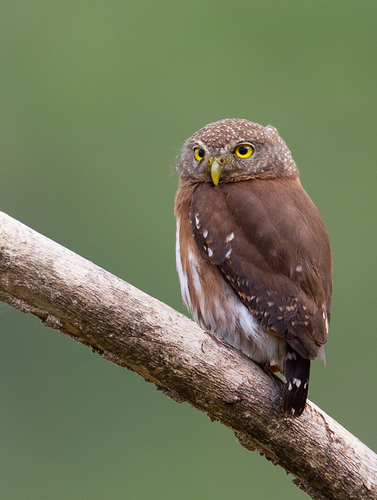
Central American Pygmy-Owl
Glaucidium griseiceps
The Central American Pygmy-Owl is a tiny but ferocious hunter of the tropical lowlands. Known for its 'false eyes' and daytime activity, this pint-sized predator is a master of the forest edge.
Quick Identification
Size
13-16 cm (5.1-6.3 in) long; wingspan approx. 30-35 cm (12-14 in); weighs 50-60 g (1.8-2.1 oz)
Colors
Greyish-brown head with fine white spotting; brown to rufous-brown back; white underparts with broad brown streaks; yellow eyes and bill; black-and-white nape ocelli (false eyes).
Key Features
- Tiny, compact body with a disproportionately large head
- Distinctive 'false eyes' on the back of the neck to confuse predators
- Grey-toned crown covered in small white dots rather than streaks
- Longish tail often held at an upward angle when perched
- Sharp, yellow eyes and a powerful hooked beak.
When You’ll See Them
Geographic range
Where Does the Central American Pygmy-Owl Live?
This captivating little owl is native to the humid tropical regions of Central America and the northwestern corner of South America. Its core range stretches from the Caribbean slope of southern Mexico through Belize, Guatemala, and Honduras, down into the lush lowlands of Costa Rica and Panama. It also extends its reach into the Chocó region of Colombia and northern Ecuador, where it thrives in dense, moisture-rich environments that provide ample cover and prey.
Basemap © OpenStreetMap contributors
Behavior
The Central American Pygmy-Owl is a feisty, pint-sized predator that is surprisingly bold for its size. Unlike many larger owls, this species is frequently active during the day, particularly on overcast afternoons or during the transitional hours of dawn and dusk. They spend much of their time perched on mid-level branches, staying perfectly still while scanning the surroundings for movement. When they spot prey, they launch a fast, direct attack, often taking down animals nearly as large as themselves.
Socially, they are typically solitary or found in pairs during the breeding season. They are highly territorial and will respond aggressively to recordings of their own calls or the mobbing sounds of small songbirds. While they don't go out of their way to interact with humans, they are often overlooked rather than shy, and can sometimes be found in well-wooded suburban gardens or plantations that border primary forests. They communicate through a series of hollow, rhythmic whistles that carry surprisingly well through the dense humid air.
EverydayEarth exclusive
Camera Tips
Capturing the Central American Pygmy-Owl on camera requires a strategic approach because of their small size and preference for the forest mid-canopy. To increase your chances, place your AI-powered camera 5 to 8 feet off the ground, angled slightly upward toward horizontal branches or snags that provide a clear view of the surrounding understory. These owls love 'scout perches' near forest edges or small clearings where they can easily spot insects and lizards moving below.
While traditional baiting isn't recommended for owls, you can attract them indirectly by creating a habitat for their prey. A small, shallow water feature or a birdbath can be a magnet for the small songbirds and lizards that the Pygmy-Owl hunts. Positioning your camera near a known nesting cavity in an old tree is also highly effective during the breeding season, which typically runs from March through June. Ensure your camera's trigger speed is set to its fastest setting, as these owls move with lightning speed when they dive after prey.
Because they are active during the day and at twilight, ensure your camera is optimized for 'low light' performance rather than just total darkness. Settings that prioritize a high shutter speed will help prevent motion blur during their characteristic tail-flicking displays. If your camera has a 'time-lapse' mode, consider using it during the peak activity hours of dawn and dusk; this can catch them even if they are perched too far away to trigger the motion sensor. Look for areas where small birds are 'mobbing' (making loud alarm calls and diving at a specific spot), as this often reveals the location of a hidden Pygmy-Owl.
Similar Species
Species that look similar or are commonly confused with Central American Pygmy-Owl.
Frequently Asked Questions
Record Central American Pygmy-Owl at your habitat
Connect a camera to start building your own species record — AI identifies every visitor automatically.