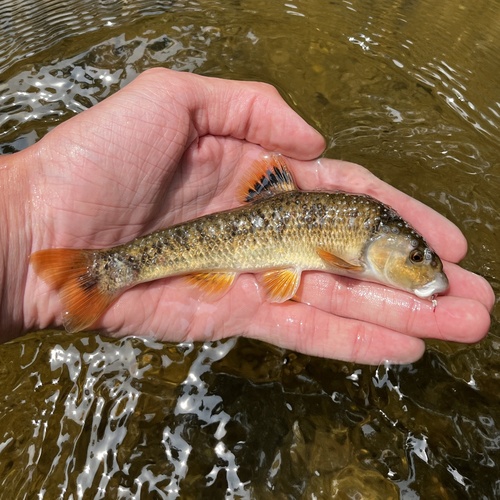
Central Stoneroller
Campostoma anomalum
The industrious "landscaper" of American streams, the Central Stoneroller is famous for its unique ability to roll stones and graze on algae. Watch these hardy minnows transform the creek bed with their incredible nest-building skills.
Quick Identification
Size
Typically 3 to 7 inches (7.5 to 18 cm) in length, weighing between 0.5 to 2 ounces (15 to 60 grams).
Colors
Olive-brown or brassy back with dark mottling; silvery-white belly. Breeding males develop orange and black bands on dorsal and anal fins.
Key Features
- Hard, cartilaginous ridge on the lower lip for scraping algae
- Large, conical white tubercles on the head and back of breeding males
- Chunky, cylindrical body with small, crowded scales near the head
- Subterminal mouth positioned downward for bottom feeding
When You’ll See Them
Geographic range
Where Does the Central Stoneroller Live?
The Central Stoneroller is native to North America, where it occupies a massive territory throughout the central and eastern regions. Its core range spans from the Great Lakes and the Hudson River drainage in the north, stretching down through the Mississippi River basin to the Gulf Coast. It is particularly common in the rocky uplands of the Ozarks and the Appalachian Mountains, though it is notably absent from the Atlantic coastal plain and the far western United States.
Basemap © OpenStreetMap contributors
Behavior
The Central Stoneroller is often described as the "landscaper" of North American streams. These industrious minnows are specialized herbivores, using a unique cartilaginous plate on their lower jaw to scrape algae and periphyton from submerged rocks. This constant grazing plays a vital role in the stream ecosystem, preventing algae from overgrowing and maintaining a healthy balance for other aquatic life.
Perhaps their most famous behavior is their namesake "stonerolling." During the spring spawning season, males become highly territorial and use their snouts to push and roll pebbles across the stream bed to create large, pit-shaped nests. They are social creatures outside of the breeding season, often found in large schools that move rhythmically across riffles. While they are generally shy around humans, they are bold when defending their nests, even using their tubercle-covered heads to drive off intruders.
EverydayEarth exclusive
Camera Tips
To capture high-quality footage of the Central Stoneroller, you must use a waterproof camera setup, such as an action camera or a submersible trail cam. The key is to locate a shallow riffle or the tail-end of a pool where the water is clear and the current is moderate. Look for rocks that appear unusually clean or "scrubbed"; these are active feeding sites where the fish have scraped away the algae.
For the most compelling behavior, aim your camera at a patch of clean gravel during the spring (March to June). This is when you can witness the males rolling stones and defending their nests. Position the camera at a low angle, nearly level with the stream bed, and weight it down with a lead weight or a heavy rock to prevent it from shifting in the current. Aiming the lens slightly upstream will help capture the fish as they face into the flow to feed.
Because water visibility is best when the sun is directly overhead, set your camera to record during the middle of the day. If your camera has a high-frame-rate setting (60fps or 120fps), use it—this allows you to see the lightning-fast scraping motions of their mouths in slow motion. Avoid areas with heavy silt, as the fish's movement will stir up clouds of mud that can obscure the lens. Instead, look for stable, rocky sections where the water remains crystal clear.
Similar Species
Species that look similar or are commonly confused with Central Stoneroller.
Frequently Asked Questions
Record Central Stoneroller at your habitat
Connect a camera to start building your own species record — AI identifies every visitor automatically.