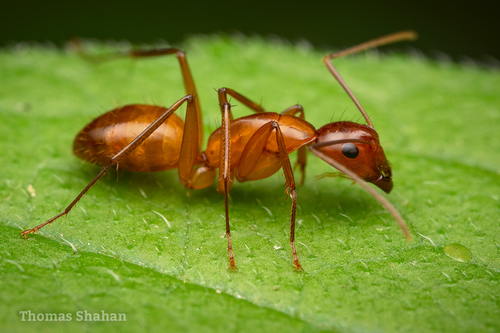
Chestnut Carpenter Ant
Camponotus castaneus
With their glowing orange bodies and impressive size, Chestnut Carpenter Ants are the hidden gems of the night-time backyard. Unlike their wood-boring cousins, these ants prefer the cool earth beneath your feet.
Quick Identification
Size
Workers range from 8–14 mm (0.3–0.55 in), while queens reach up to 20 mm (0.8 in).
Colors
Striking uniform orangish-red to chestnut brown; legs and antennae often slightly lighter or more yellowish.
Key Features
- Uniformly reddish-orange coloration across the entire body
- Smooth, continuously rounded thorax profile
- Heart-shaped head on larger major workers
- Single prominent node (petiole) between the thorax and abdomen
When You’ll See Them
Geographic range
Where Does the Chestnut Carpenter Ant Live?
The Chestnut Carpenter Ant is a native resident of North America, primarily found across the Eastern United States. Its territory stretches from the Atlantic coast as far west as the Great Plains, reaching into states like Kansas and Oklahoma. While most concentrated in the humid subtropical and temperate regions of the Southeast and Mid-Atlantic, they can be found as far north as Southern New England, thriving in areas where mature hardwood forests provide ample leaf litter and rotting wood.
Basemap © OpenStreetMap contributors
Behavior
The Chestnut Carpenter Ant is a fascinating nocturnal species that differs from many of its relatives by being primarily ground-nesting. While other carpenter ants are famous for tunneling through the structural wood of homes, Camponotus castaneus is more likely to be found in well-drained soil, under flat rocks, or within the decaying root systems of old hardwood trees. They are highly social and exhibit a complex caste system, including 'super-majors'—large-headed workers that act as the colony's heavy lifters and defenders.
Because they are most active under the cover of darkness, these ants are often missed by casual observers despite their bright, jewel-like coloring. They spend their nights foraging along the forest floor or climbing into the canopy to 'farm' aphids. In a backyard setting, they are non-aggressive unless their nest is directly disturbed, and they play a vital role in the ecosystem by cleaning up organic debris and aerating the soil.
EverydayEarth exclusive
Camera Tips
Capturing high-quality footage of Chestnut Carpenter Ants requires a specialized approach because of their nocturnal habits and small size. Use a camera with a dedicated macro lens or a high-quality 'macro mode.' Because these ants are most active in total darkness, your camera’s Infrared (IR) night vision is essential. Position the camera very low to the ground, ideally on a small tripod or mount, facing a flat piece of bark or a smooth stone where you have seen ant activity.
To draw them into the frame, use a 'sweet lure.' A small bottle cap filled with a mixture of sugar and water (or a dab of honey) works wonders. Place the bait directly in the center of your camera’s focal point. Since these ants are sensitive to vibrations, try to set up your equipment at least an hour before dusk and leave the area so they feel safe emerging from their nests.
Check the base of large oak or hickory trees for nest entrances—look for small holes in the soil surrounded by excavated dirt or bits of wood. If you are using an AI-powered camera like those from EverydayEarth, set your trigger sensitivity to high. Because ants are small, they might not trigger a standard PIR sensor; time-lapse mode set to capture an image every 30 seconds can be a more effective way to document their nocturnal foraging trails.
Frequently Asked Questions
Record Chestnut Carpenter Ant at your habitat
Connect a camera to start building your own species record — AI identifies every visitor automatically.