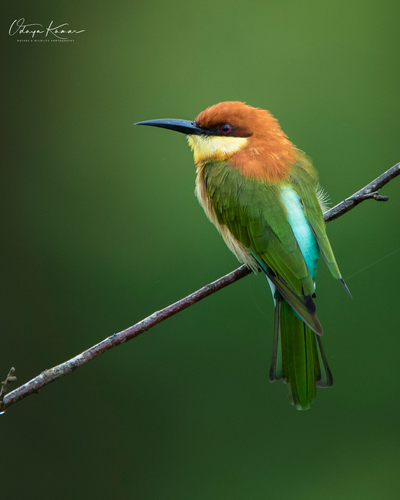
Chestnut-headed Bee-eater
Merops leschenaulti
Adorned with a fiery crown and turquoise rump, the Chestnut-headed Bee-eater is a master of the skies. This social aerialist turns every garden perch into a staging ground for its acrobatic hunting displays.
Quick Identification
Size
20–23 cm (7.8–9 in) in length; wingspan of 30–35 cm (12–14 in); weighs 25–35 grams.
Colors
Bright chestnut head, nape, and upper back; yellow throat with a thin black collar; green wings and lower back; turquoise rump; pale green underparts.
Key Features
- Rich chestnut-colored head and mantle
- Pale yellow throat bordered by a narrow black line
- Lacks long central tail streamers
- Slightly decurved, sharp black bill
When You’ll See Them
Geographic range
Where Does the Chestnut-headed Bee-eater Live?
The Chestnut-headed Bee-eater is a vibrant resident of the Asian continent, primarily found across the Indian Subcontinent and Southeast Asia. Its core range spans from the lower Himalayan foothills of India and Nepal, through Bangladesh and Sri Lanka, and extends eastward across Myanmar, Thailand, and Malaysia into the Indonesian islands of Java and Bali. While they are mostly resident throughout their range, some northern populations may engage in short-distance seasonal movements driven by the monsoon rains.
Basemap © OpenStreetMap contributors
Behavior
The Chestnut-headed Bee-eater is a highly social and gregarious bird, often found in small colonies or family groups. They are master aerialists, spending much of their day perched on exposed branches, wires, or fences, from which they launch rapid sorties to snatch flying insects out of the air. Their flight is a graceful mix of rapid flapping and long glides, allowing them to perform complex maneuvers to outwit agile prey.
When a bee-eater catches a stinging insect, it returns to its perch to perform a fascinating ritual. It beats the insect against the branch and rubs the abdomen to discharge the venom and remove the stinger before swallowing. These birds are also colonial nesters, excavating long horizontal tunnels into sandy banks or flat ground where the female lays a clutch of five to six white, spherical eggs.
EverydayEarth exclusive
Camera Tips
To capture high-quality footage of the Chestnut-headed Bee-eater, placement is everything. These birds are 'perch hunters,' meaning they return to the same vantage point repeatedly. Look for exposed, horizontal dead branches or utility wires near open spaces or water sources. Mount your camera 5 to 10 feet away from a known 'sentinel perch' at an eye-level angle to capture the brilliant chestnut plumage against a soft, out-of-focus background.
Because these birds are incredibly fast, set your AI camera to its highest trigger speed or use a 'Pre-Roll' feature if available. A side-on angle is preferable to a head-on shot, as it allows the camera to capture the full profile of the bird and its distinct lack of tail streamers. If you are using a trail camera, ensure the PIR sensitivity is set to high to pick up their small frames as they land.
Lighting plays a crucial role in bringing out the metallic greens and warm bay tones of their feathers. Position your camera facing north or south to avoid direct lens flare during the morning and afternoon peaks when they are most active. The 'golden hour' light—just after sunrise or before sunset—will make the chestnut head appear to glow, providing professional-grade wildlife shots.
In a backyard setting, you won't attract them with seeds or suet. Instead, focus on creating an insect-friendly environment. Avoiding pesticides and planting native flowering species will attract the bees and dragonflies they hunt. Providing a clean, elevated birdbath can also be a significant draw, as bee-eaters occasionally dive into the water for a quick bath or drink.
Similar Species
Species that look similar or are commonly confused with Chestnut-headed Bee-eater.
Frequently Asked Questions
Record Chestnut-headed Bee-eater at your habitat
Connect a camera to start building your own species record — AI identifies every visitor automatically.