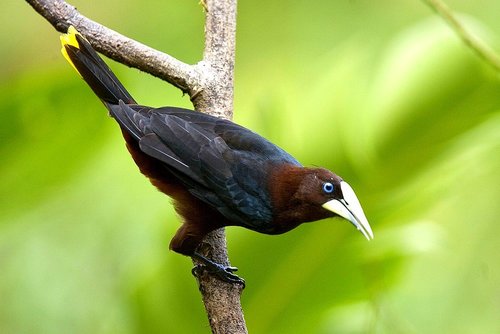
Chestnut-headed Oropendola
Psarocolius wagleri
A master of the tropical canopy, the Chestnut-headed Oropendola is famous for its intricate hanging nests and mechanical, bubbling song. With its striking ivory bill and bright yellow tail, it is one of the most charismatic birds of the Central American rainforest.
Quick Identification
Size
Males: 33–38 cm (13–15 in), 225g; Females: 27–29 cm (10.5–11.5 in), 125g
Colors
Blackish-brown body with a rich chestnut head, neck, and breast; outer tail feathers are bright yellow; bill is pale ivory/white
Key Features
- Rich chestnut head and neck contrasting with black body
- Bright yellow outer tail feathers prominent in flight
- Pale ivory or bone-colored wedge-shaped bill
- Piercing pale blue eyes
When You’ll See Them
Sightings on EverydayEarth
Apr 15, 2026
A Chestnut-headed Oropendola and a Gray-headed Chachalaca are sharing the fruit feeder, both focusing on the halved oranges provided. The Oropendola on the left uses its stout ivory bill to eat, while the Chachalaca on the right perches steadily, occasionally glancing at its surroundings.
Apr 15, 2026
Two Chestnut-headed Oropendolas are feeding on sliced oranges at the platform feeder. They use their heavy bills to pierce and tear at the fruit, while occasionally looking around the lush tropical environment.
Apr 14, 2026
A Chestnut-headed Oropendola is perched on the right side of the feeding platform, vigorously pecking at and consuming sliced oranges. The bird periodically looks around while feeding, occasionally showing its distinctive pale bill and the yellow feathers in its tail.
Apr 9, 2026
A Chestnut-headed Oropendola is perched on the feeder structure, looking around alertly while surveying the surrounding tropical vegetation. The bird remains relatively still, occasionally turning its head to scan the environment.
Apr 9, 2026
A Chestnut-headed Oropendola is perched on the fruit feeder, actively feeding on sliced oranges and scanning its surroundings.
Apr 8, 2026
A Chestnut-headed Oropendola spends the duration of the clip feeding on orange slices laid out on the wooden platform. A male Thick-billed Euphonia flies in and perches on a mossy branch directly above the fruit tray, looking around before the clip ends.
Geographic range
Where Does the Chestnut-headed Oropendola Live?
This striking species is a signature bird of the humid Neotropical lowlands. Its native range begins in southeastern Mexico and stretches south through Central America's Caribbean slope, extending into Panama, western Colombia, and northwestern Ecuador. They thrive where dense forest meets open clearings, often appearing near human settlements that provide fruit-bearing trees.
Basemap © OpenStreetMap contributors
Recorded on EverydayEarth
Behavior
The male's courtship display is a sight to behold; he grips a branch and bows forward until he is nearly upside down, fluffing his feathers and producing a series of liquid gurgles, pops, and crackles. Their flight is heavy and direct, and the specialized feathers of the males produce a distinct 'woofing' or rushing sound as they fly overhead. Outside of the breeding season, they may forage in smaller, more mobile groups.
EverydayEarth exclusive
Camera Tips
To capture the Chestnut-headed Oropendola on camera, focus your efforts on the edges of forests or near large, fruiting trees. If you have a tall platform or a way to mount your camera higher up (6–10 feet), you are more likely to catch them as they descend from the canopy. They are particularly attracted to feeding stations stocked with overripe bananas or plantains. Placing these on a sturdy wooden platform in a semi-open area will provide the best lighting and clear lines of sight.
Because these birds are highly active and the males perform rapid, jerky bowing displays, set your camera to a fast shutter speed or high-speed 'burst' mode. This will help you freeze the action during their acrobatic courtship rituals. The yellow tail feathers are highly reflective, so try to position your camera with the sun at its back to avoid blowing out the bright colors while keeping the dark body plumage detailed.
If your AI camera supports video or audio recording, ensure the microphone is active. The 'song' of the Oropendola is one of the most unique sounds in the rainforest, consisting of mechanical crashes and liquid bubbles that are as fascinating as the bird's appearance. Early morning, just after sunrise, is the peak time for activity when they are most vocal and active near their nesting colonies.
Similar Species
Species that look similar or are commonly confused with Chestnut-headed Oropendola.
Frequently Asked Questions
Record Chestnut-headed Oropendola at your habitat
Connect a camera to start building your own species record — AI identifies every visitor automatically.