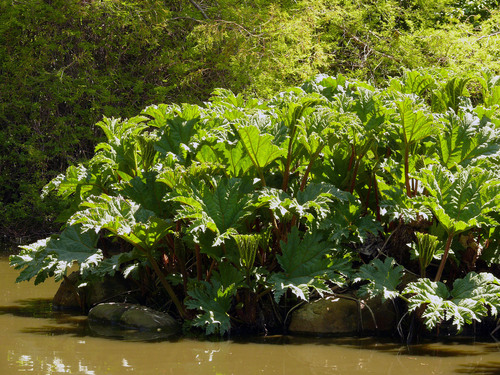
Chilean rhubarb
Gunnera tinctoria
The Chilean Rhubarb is a botanical giant, boasting leaves so large they look like they belong in a prehistoric jungle. This moisture-loving perennial can transform a damp garden corner into a dramatic, architectural landscape in just a few months.
Quick Identification
Size
Height up to 2.5m (8.2ft); individual leaves can reach 2m (6.6ft) in diameter
Colors
Bright to deep green leaves; reddish-pink veins and stems; reddish-brown cone-like flower spikes
Key Features
- Massive umbrella-like leaves with serrated edges and prickly undersides
- Thick, hairy, succulent-like stalks (petioles) often tinged with red
- Large, reddish-brown, spike-shaped flower clusters (inflorescences) emerging from the base
When You’ll See Them
Geographic range
Where Does the Chilean rhubarb Live?
The Chilean rhubarb is native to the rugged, damp landscapes of South America, specifically stretching across southern Chile and into the neighboring regions of Argentina and Bolivia. In its native range, it thrives in the cool, moist conditions of the Andes and coastal regions where water is abundant and the soil stays consistently saturated. Beyond its home continent, this massive perennial has been widely introduced as an ornamental focal point in gardens across the Northern Hemisphere and Oceania. It has become particularly well-established in the wild across the United Kingdom, Ireland, and New Zealand, where the temperate, rainy climates mimic its native habitat, allowing it to naturalize and, in some cases, become a dominant species along coastlines and riverbanks.
Basemap © OpenStreetMap contributors
Behavior
The Chilean Rhubarb is a herbaceous perennial known for its aggressive and rapid growth during the spring and summer months. While it may look like a static garden plant, it is biologically dynamic, forming a symbiotic relationship with nitrogen-fixing cyanobacteria (Nostoc) within its tissues, which allows it to thrive in nutrient-poor, boggy soils where other plants might struggle.
In the backyard ecosystem, it acts as a massive architectural shelter. Its giant leaves create a humid, shaded microclimate underneath, providing a sanctuary for amphibians, insects, and small mammals. However, its growth is so dominant that it often shades out native flora, making it a subject of management in regions where it has escaped cultivation.
EverydayEarth exclusive
Camera Tips
To capture the true majesty of the Chilean Rhubarb, your camera strategy should focus on its incredible growth rate and structural changes rather than animal-like movement. Because the leaves can reach over two meters in width, place your camera at a wide-angle setting at least 3 to 5 meters away from the base of the plant. A low-angle shot looking upward can emphasize the 'Jurassic' feel of the leaf undersides and the thick, prickly petioles.
If your AI camera supports time-lapse mode, this is the perfect subject. Set the camera to take a photo every 12 to 24 hours starting in early spring. You will be able to witness the 'alien-like' reddish flower spikes emerging first, followed by the rapid, almost aggressive unfurling of the massive leaves. This provides a fascinating look at botanical development that is often missed by the naked eye.
Wildlife cameras placed near the base of the plant can capture more than just the plant itself. The dense canopy creates a perfect 'corridor' for small mammals and a damp refuge for frogs. Position your camera to face the interior 'cavern' created by the overlapping leaves. Because this species grows near water, be sure to use a desiccant pack inside your camera housing to prevent lens fogging from the high local humidity and the plant's own transpiration.
Frequently Asked Questions
Record Chilean rhubarb at your habitat
Connect a camera to start building your own species record — AI identifies every visitor automatically.