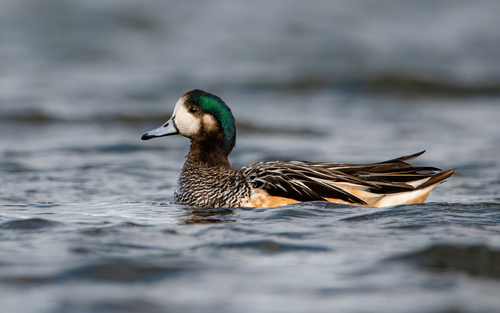
Chiloe Wigeon
Mareca sibilatrix
The Chiloé Wigeon is a stunning, whistling waterfowl native to the southern tip of South America. With its brilliant white face and iridescent green plumage, it is one of the most decorative 'grazing' ducks you can spot in temperate wetlands.
Quick Identification
Size
Length: 43-54 cm (17-21 in); Wingspan: 75-86 cm (30-34 in); Weight: 800-950 g (1.8-2.1 lbs)
Colors
Iridescent green head patch, prominent white forehead and cheeks, black and white barred breast, and warm orange-brown (rufous) flanks.
Key Features
- Bright white forehead and cheek patch
- Iridescent green patch behind the eye
- Black and white barred chest pattern
- Distinctive whistling call
- Grey bill with a black tip
When You’ll See Them
Geographic range
Where Does the Chiloe Wigeon Live?
The Chiloé Wigeon is a quintessential South American species, native to the southern half of the continent. Its core range extends from the Chiloé Archipelago and central Chile across the plains of Argentina to the Falkland Islands. During the austral winter, southern populations move north into Uruguay, Paraguay, and the southern reaches of Brazil, making them a common sight across a variety of temperate and subtropical wetlands.
Basemap © OpenStreetMap contributors
Behavior
The Chiloé Wigeon is a highly social and vocal dabbling duck, famous for the melodious whistling calls that give it the scientific name sibilatrix. Unlike many other duck species where the male is significantly more colorful than the female, both sexes of the Chiloé Wigeon display nearly identical, vibrant plumage. They are often seen in small flocks or pairs, frequently mingling with other waterfowl species in South American wetlands.
These ducks are primarily 'grazers' compared to other dabblers. While they do feed in the water by tipping their tails up to reach submerged plants, they spend a significant amount of time on land, walking through short grass to forage for clover and tender shoots. They are generally wary but can become quite accustomed to human presence in parks or suburban areas that feature large ponds and adjacent lawns.
EverydayEarth exclusive
Camera Tips
To capture the best footage of the Chiloé Wigeon, place your AI-powered camera at a low angle, roughly 6 to 10 inches off the ground, near the edge of a pond or lake. These ducks frequently come ashore to graze, so targeting the transition zone between the water and a grassy bank is ideal. Positioning the camera to face east or west will help capture the metallic green sheen of their head feathers in the soft morning or evening light without causing harsh silhouettes.
If you are using a camera with video capabilities, ensure the microphone is active. The Chiloé Wigeon is exceptionally vocal, and their bird-like whistles are a key identifying feature that adds great value to your recordings. They are most active during the early morning hours, so set your camera's sensitivity higher during the dawn window to catch them as they begin their first forage of the day.
Because they are social birds, you can often capture entire family groups. During the breeding season (spring in the Southern Hemisphere), look for areas with dense reed cover where parents might lead their ducklings. Avoid using food as a lure; instead, focus on natural grazing spots like short-mown grass or clover patches near the water's edge. A high-speed trigger is recommended, as their head movements while grazing can be rapid and may cause motion blur on slower trail cameras.
Similar Species
Species that look similar or are commonly confused with Chiloe Wigeon.
American Wigeon
The American Wigeon male has a white crown but a brownish face, whereas both sexes of the Chiloé Wigeon have a bright white face and forehead.
Eurasian Wigeon
The Eurasian Wigeon male has a distinctive chestnut-colored head with a buffy-yellow forehead, lacking the white face and green iridescence of the Chiloé.
Frequently Asked Questions
Record Chiloe Wigeon at your habitat
Connect a camera to start building your own species record — AI identifies every visitor automatically.