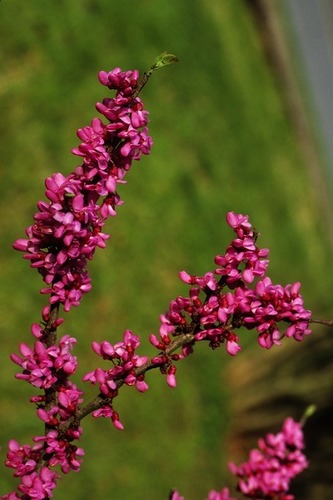
Chinese redbud
Cercis chinensis
A spring showstopper that blooms directly from its bark, the Chinese redbud is a beacon for early-season pollinators and a favorite for garden photographers. Its heart-shaped, glossy leaves and compact form make it the perfect stage for observing backyard nature.
Quick Identification
Size
Typically 3-5 meters (10-15 feet) in garden settings, occasionally reaching 9 meters (30 feet) in the wild.
Colors
Bright rose-purple or deep pink flowers; dark, glossy green heart-shaped leaves; dull brown seed pods in autumn.
Key Features
- Clusters of flowers blooming directly on the trunk and branches (cauliflory)
- Large, perfectly heart-shaped leaves with a glossy finish
- Compact, multi-stemmed growth habit
- Flat, bean-like seed pods that persist into winter
When You’ll See Them
Loading activity data...
Behavior
As the season progresses, the tree transitions from its floral display to a lush canopy of heart-shaped leaves. These leaves are thicker and glossier than other redbud species, providing excellent shade and cover for small backyard birds. In the fall, the tree produces long, flattened seed pods that turn brown and can remain on the branches well into the winter, offering a food source for foraging wildlife when other options are scarce.
EverydayEarth exclusive
Camera Tips
To capture the stunning 'cauliflory' of the Chinese redbud, position your camera just 3 to 5 feet away from a main branch or the primary trunk. Unlike most trees where you'd focus on the canopy, the 'action' here happens on the bark. Use a macro lens or a close-focus setting to document the tiny, pea-like buds as they burst through the wood. If your camera has a time-lapse mode, set it to take one photo every hour for three days during a warm spring week; the resulting video of the bark 'turning pink' is spectacular.
Because this tree is a massive nectar source in early spring, it is a magnet for 'wildlife traffic.' Position your camera at a 45-degree angle to a flowering branch to capture bees, hoverflies, and early butterflies. Since these pollinators move quickly, use a high shutter speed (at least 1/1000s) or a high-frame-rate video setting (60fps or higher). The vibrant pink flowers provide a natural high-contrast background that makes the iridescent colors of bees and butterflies pop in your footage.
In the winter months, don't move your camera! The seed pods attract ground-feeding birds and small mammals like squirrels. Angle the camera slightly downward toward the lower branches or the ground beneath the tree. The structure of the Chinese redbud, with its multiple stems, also makes it a popular night-time roosting spot for small birds like wrens. Using an infrared (IR) trail camera during the night can reveal the hidden social life of birds seeking shelter within its dense, inner branch network.
Similar Species
Species that look similar or are commonly confused with Chinese redbud.
Frequently Asked Questions
Record Chinese redbud at your habitat
Connect a camera to start building your own species record — AI identifies every visitor automatically.