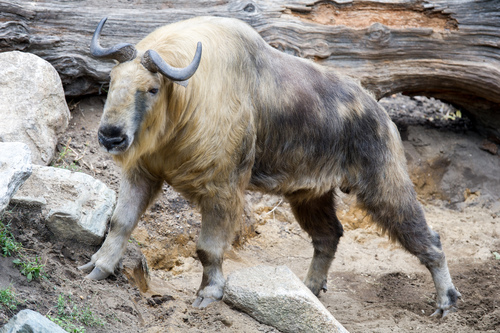
Chinese Takin
Budorcas tibetana
The Chinese Takin is the golden giant of the Himalayas, a mountain-dwelling marvel that looks like a cross between a goat and a moose. This rare and vulnerable herbivore roams the same misty bamboo forests as the Giant Panda, making it one of Asia's most iconic wilderness residents.
Quick Identification
Size
1.7-2.2m (5.5-7.2 ft) long; 1-1.3m (3.3-4.3 ft) at shoulder; 250-400kg (550-880 lbs)
Colors
Golden-yellow to brownish-gold shaggy coat; dark facial markings around the muzzle and eyes; dark dorsal stripe
Key Features
- Massive, arched 'moose-like' snout
- Short horns that grow horizontally then curve upward
- Stocky, muscular build with a thick, oily coat
- Large, two-toed hooves specialized for climbing
When You’ll See Them
Geographic range
Where Does the Chinese Takin Live?
Native to the rugged mountain ranges of East Asia, the Chinese Takin is found exclusively within the People's Republic of China. Its core population inhabits the high-altitude regions of Sichuan, Gansu, and Shaanxi provinces, as well as southeastern Tibet. These mountain specialists thrive in the remote corridors of the Min Shan and Qionglai mountains, often sharing the same mist-shrouded slopes as the Giant Panda.
Basemap © OpenStreetMap contributors
Behavior
The Chinese Takin is a fascinating social mammal that exhibits a unique blend of goat-like agility and bear-like bulk. During the summer months, these animals gather in large, boisterous herds of up to 100 individuals to graze in high-altitude alpine meadows. As the weather cools and snow begins to cover the peaks, they split into smaller family groups of roughly 20 members and migrate vertically to lower elevations, seeking the shelter of dense bamboo and coniferous forests.
Though they appear cumbersome, Takins are remarkably nimble on steep, rocky terrain. They are known for their 'cough-like' alarm calls and a deep, resonant bellow used during the mating season. While generally shy and prone to hiding in thick brush when threatened, they are formidable when cornered and will use their powerful horns to defend their territory or young. They are also known to be quite curious about new objects in their environment, often investigating trail cameras with their sensitive muzzles.
EverydayEarth exclusive
Camera Tips
Capturing the Chinese Takin on camera requires understanding their vertical migration patterns. During the summer, place your cameras near high-altitude alpine meadows and natural salt licks, which are major attractants for this species. Because they are heavy, powerful animals, use a high-tension security strap and a protective metal lock box. Takins are notorious for rubbing their oily coats against trees and equipment, which can easily knock a standard mount out of alignment or smudge the lens.
Position your camera at a height of approximately 1 to 1.2 meters (about 3.5 to 4 feet) to capture their massive heads and distinctive horn structures. Since they are most active during the low-light hours of dawn and dusk (crepuscular behavior), high-quality infrared sensors and a fast trigger speed are essential. Avoid cameras with white flashes, as these can startle the herd and may discourage them from returning to that specific trail.
Look for 'takin highways'—well-worn paths through dense bamboo or rhododendron thickets. These paths are often marked by stripped bark and tufts of golden wool snagged on branches. In the winter, move your camera setups to lower elevations, specifically focusing on narrow valleys and south-facing slopes where the snow is thinner. Setting the camera to 'burst mode' or short video clips is highly recommended, as Takins usually travel in groups, and a single photo might miss the social interactions or the calves following the dominant females.
Similar Species
Species that look similar or are commonly confused with Chinese Takin.
Frequently Asked Questions
Record Chinese Takin at your habitat
Connect a camera to start building your own species record — AI identifies every visitor automatically.