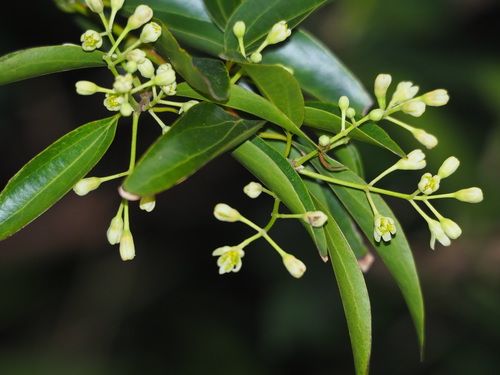
Cinnamon tree
Cinnamomum burmanni
Famous for its aromatic 'Korintje' spice and stunning reddish new foliage, the Cinnamon tree is a cornerstone of Southeast Asian tropical forests and a favorite for fruit-eating backyard birds.
Quick Identification
Size
A medium-sized evergreen reaching 7–20 metres (23–65 feet) in height, with a trunk diameter of up to 40 cm (16 inches).
Colors
Glossy dark green mature leaves, vibrant reddish-pink new growth, and smooth grey-brown bark.
Key Features
- Glossy, leathery leaves with three distinct longitudinal veins
- Fragrant bark and leaves when crushed
- New leaf growth appears in striking shades of red or pink
- Small, pale yellow-white flowers
- Small, dark purple to black berry-like fruits (drupes)
When You’ll See Them
Geographic range
Where Does the Cinnamon tree Live?
The Cinnamon tree is native to the humid, tropical regions of Southeast Asia, with its primary ancestral home located in Indonesia, particularly on the island of Sumatra, as well as parts of Malaysia and southern China. Because of its value as a spice crop, it has been widely introduced and naturalized across several continents. Today, established populations can be found in the Hawaiian Islands, parts of the Caribbean, and Central America, where it thrives in warm, moist climates similar to its native Malay Archipelago.
Basemap © OpenStreetMap contributors
Behavior
The Cinnamon tree, specifically the Cinnamomum burmanni species, is a hardy evergreen known for its aromatic properties and its role in the spice trade. In its natural environment, it grows as a mid-canopy tree, providing a dense, year-round screen of foliage. Unlike many trees that have a single flush of growth, the Cinnamon tree often displays "red flushing," where new leaves emerge in bright shades of pink or burgundy to protect them from sun damage and herbivory before they harden and turn green.
While it is a stationary plant, it plays a dynamic role in its ecosystem. It is a major food source for various fruit-eating birds, which consume its small purple drupes and subsequently disperse its seeds. In human-populated areas, it is often utilized as an ornamental or shade tree. However, its vigorous growth and easy seed dispersal mean it can become invasive in tropical regions outside its native range, where it outcompetes local vegetation for sunlight and soil nutrients.
EverydayEarth exclusive
Camera Tips
When setting up an AI-powered camera to monitor a Cinnamon tree, focus on the canopy and the fruiting clusters rather than just the trunk. This species is a magnet for frugivorous birds like bulbuls and waxwings. Mount your camera on a nearby structure or a stable branch at a height of 5 to 10 feet, angling it slightly downward toward a cluster of ripening purple berries. This positioning will capture the activity of birds as they land to feed, providing much more dynamic footage than a static shot of the trunk.
To showcase the tree's unique growth patterns, use a time-lapse setting over a period of 2 to 3 weeks during the spring. This will allow you to capture the "red flush" phenomenon, where the tips of the branches transform from bright pink to deep green. For best results, ensure the camera is positioned to avoid direct midday glare on the glossy leaves, which can cause overexposure; dappled morning light often provides the most professional-looking results for foliage.
If you are interested in the ground-level ecosystem, place a secondary camera at the base of the tree. Small mammals and ground-feeding birds often visit to forage for fallen fruits. Because the bark is relatively smooth, it doesn't offer much texture for climbing mammals like some oaks do, so focus your ground camera on the area immediately around the roots where the leaf litter accumulates, as this is where most foraging activity will occur.
Frequently Asked Questions
Record Cinnamon tree at your habitat
Connect a camera to start building your own species record — AI identifies every visitor automatically.