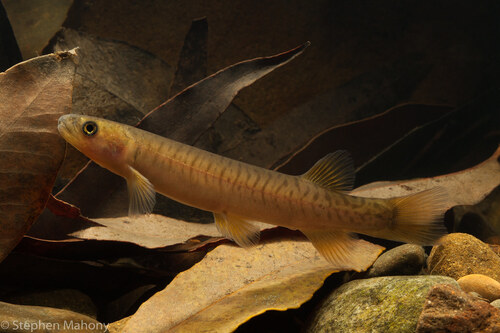
Climbing Galaxias
Galaxias brevipinnis
The ultimate mountaineer of the underwater world, the Climbing Galaxias can scale vertical waterfalls using only its fins. This elusive, nocturnal native is a master of camouflage in the rocky streams of Australia and New Zealand.
Quick Identification
Size
Usually 15–18 cm (6–7 in), but can reach up to 28 cm (11 in) in length.
Colors
Olive-brown to amber with dark, irregular mottling or chevron-like patterns; the belly is typically silvery-white.
Key Features
- Broad, fan-shaped pectoral fins positioned low on the body
- Elongated, scaleless body with a thick, leathery skin
- Dorsal and anal fins set far back toward the tail
- Prominent, dark eyes with a gold-flecked iris
When You’ll See Them
Geographic range
Where Does the Climbing Galaxias Live?
The Climbing Galaxias is native to the cool-temperate regions of the Southwestern Pacific, predominantly found throughout New Zealand and the coastal regions of southeastern Australia, including Tasmania. Their reach extends to several subantarctic islands such as the Auckland and Campbell Islands, as well as the Chatham Islands. While they are naturally amphidromous—migrating between freshwater and the sea—several landlocked populations have successfully established themselves in high-country lakes and reservoirs.
Basemap © OpenStreetMap contributors
Behavior
The Climbing Galaxias, also known as the Kōaro, is a marvel of the freshwater world, famous for its ability to scale vertical rock faces and waterfalls. Using its broad, textured pectoral fins like suction cups and undulating its body, it can navigate obstacles that would stop almost any other fish. This behavior allows them to colonize high-altitude streams and remote headwaters, often living above waterfalls that exclude predatory fish.
Predominantly nocturnal, these fish spend their daylight hours hidden deep within the crevices of rocky stream beds or tucked under submerged logs. They are solitary and can be quite territorial regarding their preferred hiding spots. Unlike many other galaxiids that swim in the open water column, the Climbing Galaxias is a bottom-dweller, staying close to the substrate where the current is slowest.
In the wild, they are highly sensitive to vibrations and light changes, darting into cover at the slightest sign of danger. While they are not traditionally social with humans, their presence is a key indicator of a healthy, forested stream ecosystem with high water quality.
EverydayEarth exclusive
Camera Tips
Capturing the Climbing Galaxias requires an underwater setup, such as a waterproof action camera or a specialized creek-cam. Because they are strictly nocturnal, your camera must have strong infrared (IR) night vision. Position the camera in a 'riffle'—a shallow section of the stream where water flows over rocks—as these fish often come out into these areas at night to hunt for drifting larvae. A side-on angle about 2-3 inches from the stream bed is ideal for capturing their unique profile.
To document their incredible climbing ability, look for wet, mossy rock faces or the concrete walls of small weirs during a rainy night in spring. This is when juveniles (whitebait) and even adults are most likely to be moving upstream. Secure your camera to a weighted tripod or a heavy stone to prevent it from being swept away by the current, and ensure the lens is clean of algae or silt before deployment.
Avoid using bright white lights, as these will cause the fish to flee immediately; instead, rely on the 940nm 'no-glow' IR LEDs found on high-end trail cameras. If your stream is in a backyard setting, creating a 'choke point' with stones can funnel the fish directly in front of your lens. Early spring is the most active time to witness migration patterns, while the height of summer is best for observing territorial feeding behavior in deep, cool pools.
Frequently Asked Questions
Record Climbing Galaxias at your habitat
Connect a camera to start building your own species record — AI identifies every visitor automatically.