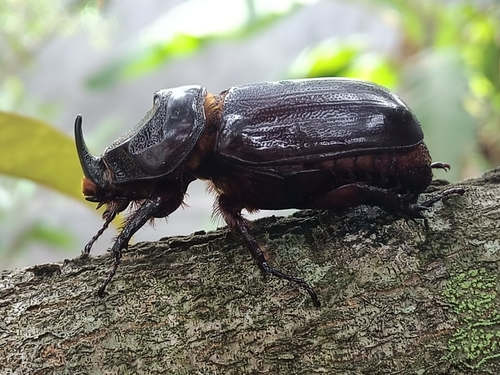
Coconut Rhinoceros Beetle
Oryctes rhinoceros
With its prehistoric horn and glossy black armor, the Coconut Rhinoceros Beetle is a heavy-weight titan of the tropical night. Though a formidable sight in backyard palm trees, this nocturnal giant is more interested in sweet sap than anything else.
Quick Identification
Size
30 to 60 mm (1.2 to 2.4 inches) in length and about 14 to 21 mm (0.5 to 0.8 inches) in width.
Colors
Uniformly dark brown to black with a shiny, polished appearance; ventral (underside) side often has reddish-brown hairs.
Key Features
- Prominent upward-curving horn on the head (larger in males)
- Large, cylindrical, heavy-set body
- Glossy dark brown to black exoskeleton
- Strong, spiny legs designed for digging and clinging
- Coarse pits or punctures visible on the wing covers
When You’ll See Them
Geographic range
Where Does the Coconut Rhinoceros Beetle Live?
Native to the tropical regions of South and Southeast Asia, the Coconut Rhinoceros Beetle is most commonly found throughout India, Sri Lanka, Malaysia, Indonesia, the Philippines, and Southern China. In recent decades, it has significantly expanded its footprint as an invasive species, establishing large populations across the Pacific Islands, including Guam, Fiji, Samoa, and more recently, the Hawaiian Islands. This beetle thrives in warm, humid climates where palm species are abundant, particularly in coastal lowlands and managed agricultural zones.
Basemap © OpenStreetMap contributors
Behavior
The Coconut Rhinoceros Beetle is a primarily nocturnal insect that spends its daylight hours hidden in breeding sites or burrowed into the crowns of host trees. They are powerful fliers, often taking to the air shortly after dusk to locate fresh palm trees or mating partners. Their movement is somewhat lumbering and heavy, making a distinct buzzing sound when in flight.
Unlike many beetles where the larvae cause the most visible damage, it is the adult Coconut Rhinoceros Beetle that poses the greatest threat to vegetation. They use their powerful horns and legs to bore into the tightly packed developing fronds at the top of palm trees. This boring behavior is not for consumption of the wood itself, but to reach the nutrient-rich sap. They are generally solitary but may congregate in areas with high food density or ideal breeding conditions, such as large piles of decaying organic matter.
While they are often viewed as a significant agricultural pest due to the damage they cause to coconut and oil palms, they are harmless to humans. They do not bite or sting, though their spiny legs can feel quite prickly if they crawl on bare skin. In suburban environments, they are frequently drawn to bright porch lights or street lamps during their nightly excursions.
EverydayEarth exclusive
Camera Tips
To capture the Coconut Rhinoceros Beetle on camera, focus your efforts on their primary food source: palm trees. Mount your camera 5 to 10 feet up the trunk of a coconut, date, or oil palm, angling the lens slightly upward toward the crown where adults are most likely to land. Since they are strictly nocturnal, a camera with high-quality infrared (IR) LEDs or a dedicated 'no-glow' flash is essential to avoid overexposing the beetle’s shiny, reflective exoskeleton.
Another highly effective strategy is to place your camera near known breeding sites. Look for piles of decaying mulch, old compost heaps, or rotting palm stumps. Set the camera on a tripod or low-level mount about 2 feet off the ground, facing the base of the organic pile. You can often catch the heavy beetles landing or crawling into these areas to lay eggs. If you are using a trigger-based camera, set the sensitivity to high, as insects can sometimes fail to trigger PIR sensors designed for larger mammals.
For the best results, utilize a light lure. These beetles are strongly attracted to ultraviolet (UV) and bright white lights. Placing a light source just out of the camera's frame—directed at a white sheet or a palm trunk—can draw them directly into your field of view. Be sure to set your camera to take short video clips (10-15 seconds) rather than just photos; the way they use their horns to wedge themselves into tight spaces is a fascinating behavior that is best captured in motion.
Similar Species
Species that look similar or are commonly confused with Coconut Rhinoceros Beetle.
Frequently Asked Questions
Record Coconut Rhinoceros Beetle at your habitat
Connect a camera to start building your own species record — AI identifies every visitor automatically.