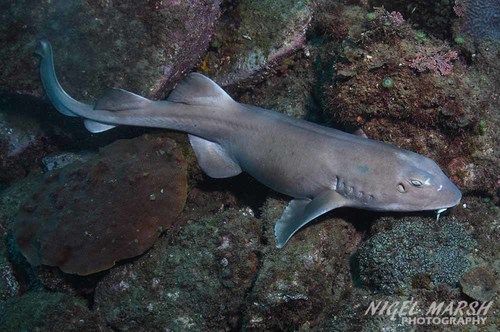
Colclough's Shark
Brachaelurus colcloughi
A rare and striking carpet shark found only in the shallow, sun-drenched waters of northeastern Australia. Known for its 'blind' behavior and dramatic juvenile markings, it is a treasure of the Queensland coastline.
Quick Identification
Size
Grows to a maximum length of 76 cm (30 in)
Colors
Adults are typically a uniform grayish-brown to golden-brown; juveniles exhibit a striking high-contrast pattern of black and white bands and spots.
Key Features
- Long nasal barbels with posterior skin flaps
- Two dorsal fins set far back on the body
- Large gap between the anal fin and the caudal fin
- Stocky body with a wide, flattened head
When You’ll See Them
Geographic range
Where Does the Colclough's Shark Live?
Native to the continent of Australia, Colclough's Shark is an endemic species with a very restricted range. It is found exclusively along the northeastern coastline of Australia, primarily concentrated in the subtropical waters of southern Queensland and northern New South Wales. This species is a true local, rarely venturing far from the sheltered bays and shallow reef systems of the Coral Sea coast.
Basemap © OpenStreetMap contributors
Behavior
Colclough's Shark, also known as the bluegrey carpetshark, is a shy and largely sedentary bottom-dweller. During the daylight hours, they are masters of concealment, often found wedged into rocky crevices, tucked under ledges, or hiding within thick seagrass beds. They are primarily nocturnal, emerging under the cover of darkness to cruise the seafloor in search of prey. Because they frequent very shallow water, they are occasionally encountered by snorkelers or seen in tide pools.
Despite their shark lineage, they are harmless to humans and tend to be quite sluggish. Their most unique behavior involves their defense mechanism; like their close relative the Blind Shark, they may close their thick eyelids when removed from the water, leading to their common nickname. They are solitary creatures that do not form schools, though several individuals may be found in the same high-quality habitat if food is abundant.
EverydayEarth exclusive
Camera Tips
Capturing a Colclough's Shark on camera requires an underwater setup, such as a GoPro or a specialized Baited Remote Underwater Video (BRUV) system. For coastal residents with property backing onto canals or bays in Queensland, the best approach is to submerge a camera near a structure like a private jetty or a rocky seawall. Position the camera about 30-50 cm off the seabed, facing a clear patch of sand adjacent to a reef or seagrass edge.
To lure this elusive shark into view, use a mesh bait bag containing oily fish like sardines or mullet. Secure the bait bag approximately one meter in front of the lens. Because these sharks are nocturnal, you will need an underwater light source. Use a red-filtered light if possible, as it is less likely to spook the shark than a harsh white beam. This will allow you to record their natural foraging behavior without them darting away.
Since Colclough's Sharks are slow movers, set your camera to a standard frame rate (30fps or 60fps) rather than slow motion. Check the tides before deployment; the hour surrounding high tide at night is often the most productive time as sharks move into shallower areas to feed. Ensure your camera housing is weighted properly so it doesn't shift with the current or surge.
Similar Species
Species that look similar or are commonly confused with Colclough's Shark.
Frequently Asked Questions
Record Colclough's Shark at your habitat
Connect a camera to start building your own species record — AI identifies every visitor automatically.