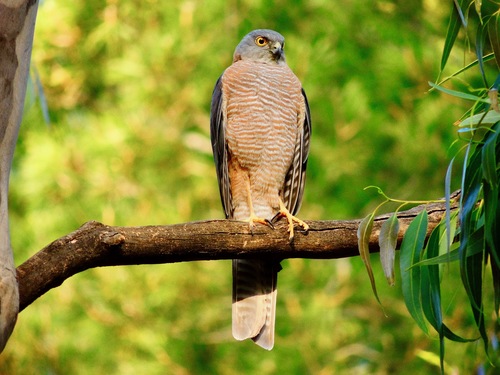
Collared Sparrowhawk
Tachyspiza cirrocephala
A master of stealth and speed, the Collared Sparrowhawk is the ultimate backyard acrobat. This slender raptor is a specialist in navigating thick foliage to surprise its prey, making it a thrilling find for any backyard birdwatcher.
Quick Identification
Size
Length: 29–38 cm (11.4–15 in); Wingspan: 55–78 cm (21.6–30.7 in); Weight: 100-250g (3.5–8.8 oz)
Colors
Slate-grey to blue-grey upperparts with a reddish-brown 'collar' on the neck. Underparts are finely barred with rufous and white. Bright yellow eyes and cere.
Key Features
- Distinct chestnut-colored collar on the nape
- Long, slender middle toe projecting beyond other claws
- Square-tipped tail when folded or in flight
- Slight brow ridges giving a 'startled' expression
When You’ll See Them
Geographic range
Where Does the Collared Sparrowhawk Live?
Native to the Oceania region, the Collared Sparrowhawk is a widespread resident across the Australian mainland, Tasmania, and New Guinea. It is also found on several Indonesian islands including the Moluccas and Lesser Sundas. These adaptable raptors thrive across diverse landscapes, from the humid tropical north to the temperate south, provided there is enough tree cover for nesting and hunting.
Basemap © OpenStreetMap contributors
Behavior
The Collared Sparrowhawk is a master of stealth and high-speed maneuvers. Unlike larger raptors that soar high in the sky, this specialist hunter prefers to stay low, utilizing thick vegetation as cover. It is an ambush predator, often sitting motionless on a concealed perch for long periods before launching a sudden, explosive dash to intercept a smaller bird in mid-air.
In suburban environments, these hawks have become remarkably bold. They are known to 'raid' backyard bird feeders, not for the seeds, but for the gathered finches and honeyeaters. While they are generally solitary, they can be quite vocal during the breeding season, emitting a rapid, high-pitched 'kee-kee-kee' call that often alerts local songbirds to their presence.
EverydayEarth exclusive
Camera Tips
To capture the Collared Sparrowhawk on camera, focus your efforts on water sources. These hawks frequently visit birdbaths, not just to drink, but to hunt other birds that are distracted while bathing. Position your camera at a low angle facing the birdbath, ensuring you have a wide enough field of view to capture their lightning-fast entry and exit from the frame.
Identify 'staging perches' in your yard—horizontal branches with a clear view of feeding or watering areas. Sparrowhawks will often sit here for minutes at a time before striking. Mounting a camera with a motion-trigger near these branches can provide high-resolution portraits that are otherwise difficult to get. Because they are so fast, use the highest frame rate or 'burst mode' available on your device.
Avoid using meat as bait, as these birds are triggered by the movement of live prey. Instead, create a bird-friendly habitat with native shrubs to attract their natural prey. If you have a bird feeder, place your camera 10 to 15 feet away, angled toward the side of the feeder. The hawk usually strikes from a blind spot, and this setup increases your chances of capturing the dramatic moment of a hunt.
Similar Species
Species that look similar or are commonly confused with Collared Sparrowhawk.
Frequently Asked Questions
Record Collared Sparrowhawk at your habitat
Connect a camera to start building your own species record — AI identifies every visitor automatically.