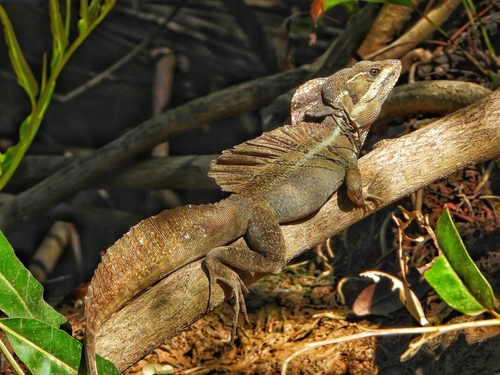
Common Basilisk
Basiliscus basiliscus
Meet the 'Jesus Lizard,' a prehistoric-looking marvel capable of walking on water. With its magnificent sail-like crests and incredible speed, the Common Basilisk is the ultimate prize for any tropical backyard explorer.
Quick Identification
Size
Total length up to 75–80 cm (2.5–2.6 ft); snout-to-vent length is about 25 cm (10 in). Weight 200–600g (0.4–1.3 lbs).
Colors
Olive, brown, or bronze with cream or yellow stripes along the flanks. Males possess high, sail-like crests on the head, back, and tail.
Key Features
- Prominent crests on head, back, and tail in males
- Specialized fringed scales on rear toes for water-running
- Long, whip-like tail used for balance
- Bright yellow or orange iris
When You’ll See Them
Sightings on EverydayEarth
Jul 24, 2026
A male Common Basilisk is perched on the wooden feeder platform among several sliced oranges and other fruits. It remains mostly still, occasionally turning its head to scan the surrounding rainforest environment.
Geographic range
Where Does the Common Basilisk Live?
The Common Basilisk is native to the tropical regions of Central and South America. Its primary range stretches from central Nicaragua through Costa Rica and Panama into the northwestern lowlands of Colombia and Venezuela. Beyond its native habitat, the species has successfully established invasive populations in South Florida, particularly along the warm, slow-moving canal systems of the Everglades and surrounding suburban areas.
Basemap © OpenStreetMap contributors
Behavior
The Common Basilisk is a highly active, diurnal lizard famously known for its ability to sprint across the surface of water for distances of up to 20 meters. This remarkable feat, which earned it the nickname "Jesus Lizard," is accomplished by unfurling specialized fringes on its rear toes that create air pockets, allowing the lizard to stay afloat if it maintains a high enough speed. This is primarily a defense mechanism used to escape predators like raptors or snakes when the lizard is startled from its basking spot.
Beyond its aquatic acrobatics, the basilisk is an agile climber and a strong swimmer. They spend a significant portion of their day basking on low-hanging branches or rocks near the water's edge to regulate their body temperature. While they are generally solitary and territorial, they can be found in high densities in areas with abundant food and ideal basking sites. Their interaction with humans is limited; they are exceptionally skittish and will often dive into the water or vanish into thick foliage at the slightest vibration or movement.
EverydayEarth exclusive
Camera Tips
To capture the Common Basilisk on camera, placement is everything. These lizards are semi-aquatic and spend a huge portion of their day basking to digest their food. Look for logs, flat rocks, or low-hanging branches that extend over the water's edge. Mount your camera at a low angle, roughly 12-18 inches above the ground or water level, aimed at these sun-drenched spots. Because they are cold-blooded, they are most active when the sun is at its peak, so ensure your camera is positioned to avoid direct lens flare during midday.
Since the basilisk's most famous behavior—running on water—happens in a flash, you should prioritize high-speed video settings. If your camera supports it, record at 60 frames per second (fps) or higher. This will allow you to slow down the footage later to see the individual foot slaps that keep the lizard afloat. Set your PIR (passive infrared) sensor to high sensitivity, as these lizards are sleek and may not always trigger sensors calibrated for larger, warmer mammals.
While you cannot easily bait a basilisk with food, you can attract them by maintaining a habitat they love. If you have a backyard pond or canal access, keep the shoreline vegetation lush but provide a few clear, flat rocks for sunning. In Florida or Central America, a small dripping water feature can sometimes pique their curiosity. Remember that they are incredibly wary; avoid checking your camera during the heat of the day when they are most likely to be active, as your presence will drive them into hiding for hours.
Similar Species
Species that look similar or are commonly confused with Common Basilisk.
Frequently Asked Questions
Record Common Basilisk at your habitat
Connect a camera to start building your own species record — AI identifies every visitor automatically.