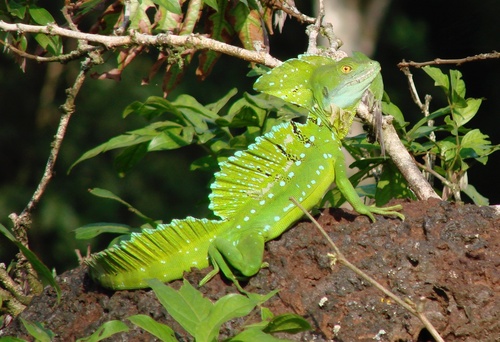
Green Basilisk
Basiliscus plumifrons
Meet the 'Jesus Christ lizard,' a brilliant emerald reptile famous for its gravity-defying ability to run across water. With its striking sails and prehistoric silhouette, the Green Basilisk is one of the most spectacular sights in the tropical Americas.
Quick Identification
Size
24-36 inches (60-91 cm) in total length; weight 7-21 oz (200-600g)
Colors
Brilliant emerald green body with small bluish-white or turquoise spots; males have large, prominent crests on the head, back, and tail.
Key Features
- Three distinct sail-like crests on head, back, and tail (males only)
- Vibrant green skin with light blue speckling
- Bright yellow or orange irises
- Extremely long, whip-like tail comprising two-thirds of body length
- Specialized scales on toes for walking on water
When You’ll See Them
Geographic range
Where Does the Green Basilisk Live?
The Green Basilisk is native to the lush, humid lowlands of Central America. Its primary range extends from eastern Honduras, through Nicaragua and Costa Rica, reaching as far south as western Panama. In addition to its native tropical haunts, established introduced populations have become a common sight in South Florida, where they frequent man-made canals and suburban garden ponds that mimic their natural riverside habitats.
Basemap © OpenStreetMap contributors
Behavior
The Green Basilisk is a highly active and agile lizard, most famous for its incredible ability to sprint across the surface of water to escape predators. Using specialized fringes on its toes that create tiny air pockets, it can maintain enough speed to stay buoyant, earning it the nickname "Jesus Christ lizard." While they are primarily arboreal, they are never far from a water source, where they dive and remain submerged for up to 30 minutes if threatened.
These lizards are diurnal and fiercely territorial. Males spend a significant portion of their day basking in the sun to regulate their body temperature, often positioning themselves on high branches overhanging rivers. They use their impressive crests and rhythmic head-bobbing to communicate with females and ward off rival males. Despite their prehistoric appearance and dramatic displays, they are extremely skittish and will flee into the canopy or water at the slightest vibration or movement.
EverydayEarth exclusive
Camera Tips
To capture the elusive Green Basilisk, you must think like a reptile that needs both safety and sun. Position your camera near "basking highways"—horizontal branches that hang over water or large, sun-exposed logs near a shoreline. Because these lizards are cold-blooded, they are most predictable between 9:00 AM and 11:00 AM when they move to sunny spots to warm up after a cool night. Set your camera at a 45-degree angle to the basking spot to capture their full prehistoric profile and the vibrant green of their crests.
Speed is critical when dealing with this species. They can transition from a stationary bask to a full-speed water sprint in a fraction of a second. Use a camera with a high trigger speed (0.2 seconds or less) and set it to video mode if possible. Capturing a 20-second 4K clip is far more rewarding than a still photo, as it may catch their unique bipedal running motion or their impressive diving behavior. Ensure your camera is high enough to avoid being splashed by rising water but low enough to capture the lizard’s eye level, typically 2 to 4 feet off the ground.
In suburban settings, Green Basilisks are attracted to the sound of running water and the presence of prey. If you have a backyard pond, placing the camera near a waterfall feature is a high-percentage strategy. While they aren't traditionally lured by bait, a small dish of live mealworms or very ripe tropical fruits like papaya or figs placed on a basking log can encourage them to linger longer in front of the lens. Be mindful of lighting; the deep green of their scales can look dark in heavy shade, so look for spots with dappled sunlight that will make their turquoise spots pop without overexposing the image.
Similar Species
Species that look similar or are commonly confused with Green Basilisk.
Frequently Asked Questions
Record Green Basilisk at your habitat
Connect a camera to start building your own species record — AI identifies every visitor automatically.