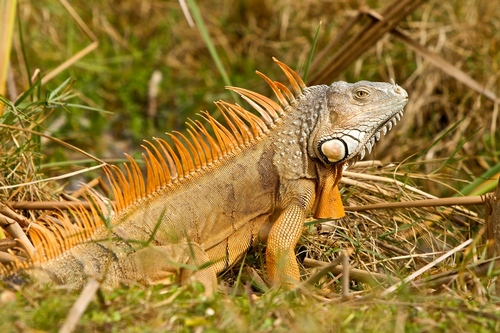
Green Iguana
Iguana iguana
The Green Iguana is a prehistoric-looking giant that has mastered the art of living in both the wild jungle and the suburban backyard. With their vibrant colors and impressive spines, they are a favorite for backyard camera enthusiasts across the tropics.
Quick Identification
Size
Up to 1.5–2 metres (5–6.6 feet) in length including tail; weight ranges from 4–9 kg (9–20 lbs).
Colors
Bright green in juveniles; adults transition to grayish-green or dull brown. Breeding males often display vibrant orange or pinkish-red hues on their heads and spines.
Key Features
- Large circular scale on the jowl known as the subtympanic shield
- Prominent dewlap (throat fan) used for communication
- A row of soft spines along the neck and back
- Long, powerful tail with dark, ringed bands
When You’ll See Them
Geographic range
Where Does the Green Iguana Live?
The Green Iguana is native to a vast region of the Americas, stretching from southern Brazil and Paraguay up through Central America to Mexico. Because of their popularity in the pet trade, they have successfully established thriving introduced populations in Florida, Hawaii, and several Caribbean islands where they were not originally found. They are lowland specialists that thrive in hot, humid environments, particularly those with easy access to water and high basking perches.
Basemap © OpenStreetMap contributors
Behavior
Green Iguanas are primarily diurnal and arboreal, meaning they spend the majority of their daylight hours high in the tree canopy. They are master thermoregulators, spending several hours each morning basking in the sun to raise their body temperature before they begin foraging for food. Despite their heavy appearance, they are agile climbers and surprisingly strong swimmers, often leaping into bodies of water from overhanging branches to escape perceived threats.
Socially, they are generally solitary but can be found in groups around prime basking spots or food sources. They communicate through a complex series of head bobs and by extending their large dewlaps to signal dominance or attract mates. In areas where they live alongside humans, they can become quite bold, often frequenting gardens or lounging on pool decks, though they will typically retreat if approached too quickly.
EverydayEarth exclusive
Camera Tips
To capture the best Green Iguana footage, you need to think like a lizard. Position your camera to face 'thermoregulation hotspots'—this includes the tops of wooden fences, flat dock surfaces, or horizontal branches that receive unobstructed morning sunlight. Iguanas are creatures of habit and will often return to the exact same spot every morning between 9 AM and 11 AM to warm up. A camera mounted 3 to 5 feet off the ground, angled slightly upward toward these basking spots, works best.
Since these are herbivores, you won't have luck with standard meat-based lures. Instead, use visual attractants. Brightly colored flowers like hibiscus or pieces of overripe fruit like melon or banana can entice them into your camera's field of view. Place these lures on a clear patch of ground or a low platform where the camera has a clean line of sight, ensuring the background isn't too cluttered so the AI can easily identify the movement.
During the peak of summer, iguanas are very fast and can trigger a camera and move out of frame before the shutter fires. Use a 'High' sensitivity setting for your PIR sensor and set your camera to take 3-photo bursts or 15-second video clips. In areas like Florida where they are active near water, setting your camera at a low angle along the edge of a canal or pond can capture them swimming or 'walking' along the shoreline, providing a unique perspective on their semi-aquatic lifestyle.
Similar Species
Species that look similar or are commonly confused with Green Iguana.
Black Spiny-tailed Iguana
Smaller than the Green Iguana, they lack the large circular jowl scale and have noticeably spikier, keeled scales on their tails.
Green Basilisk
Much smaller and more slender; they possess a distinct sail-like crest on their back and head, and lack the Green Iguana's heavy jowl.
Frequently Asked Questions
Record Green Iguana at your habitat
Connect a camera to start building your own species record — AI identifies every visitor automatically.