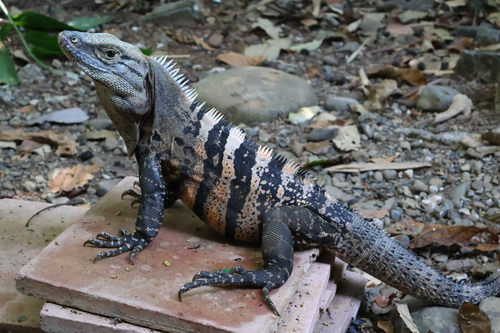
Black Spiny-tailed Iguana
Ctenosaura similis
Meet the world's fastest lizard, an armored speedster that thrives in the heat. With its prehistoric spines and lightning-quick reflexes, the Black Spiny-tailed Iguana is a master of the rocky tropics.
Quick Identification
Size
Total length up to 1.3 meters (4.3 feet); weight typically 1 to 2 kg (2.2 to 4.4 lbs)
Colors
Adults are typically grayish-tan or black with 4-12 distinct dark dorsal bands. Juveniles are a vibrant leaf-green that fades with age.
Key Features
- Distinctive whorls of sharp, spiny scales along the entire length of the tail
- Crest of long spines running down the center of the back
- Large, muscular jowls and a visible dewlap in mature males
- Fast, athletic build with long toes and sharp claws
When You’ll See Them
Sightings on EverydayEarth
Jun 28, 2026
A Black Spiny-tailed Iguana is seen climbing and resting on a large tree branch in the right side of the frame. It moves deliberately, adjusting its grip on the bark and looking around. Human voices in the background can be heard commenting on the animal's behavior near the feeder.
Jun 20, 2026
A Black Spiny-tailed Iguana rests calmly on a branch in the lower foreground of the frame. It remains mostly immobile, observing the lush tropical forest while the wind rustles through the surrounding canopy.
Jun 17, 2026
A bright green juvenile Black Spiny-tailed Iguana is perched on a large horizontal branch on the right side of the frame. It remains largely still, blending with the lush foliage, though it occasionally shifts its head to observe the environment. The surrounding tropical forest is dense with green leaves and a suspended bird feeder hangs in the mid-ground.
Jun 16, 2026
A Black Spiny-tailed Iguana is perched on a large branch on the right side of the frame. It remains mostly stationary throughout the clip, with its long tail and spiked dorsal ridge visible. The surrounding forest canopy sways gently in the wind.
Apr 4, 2026
A Scarlet Macaw perches on the wooden feeder, actively sorting through and eating seeds. Meanwhile, a Black Spiny-tailed Iguana rests on the mossy tree trunk to the left, occasionally turning its head to observe the macaw and the surrounding canopy.
Geographic range
Where Does the Black Spiny-tailed Iguana Live?
Native to the sun-drenched regions of Central America and Mexico, the Black Spiny-tailed Iguana is a staple of the Neotropical landscape. Its core range extends from the Isthmus of Tehuantepec in Mexico southward through the Pacific lowlands of Central America into Panama. In recent decades, this adaptable species has successfully established itself as an invasive resident in South Florida and the Florida Keys, where the subtropical climate mimics its native habitat perfectly.
Basemap © OpenStreetMap contributors
Behavior
The Black Spiny-tailed Iguana is a high-energy, diurnal reptile known for its incredible speed; it currently holds the Guinness World Record for the fastest lizard, clocked at speeds over 21 miles per hour. They are primarily terrestrial lizards but are highly skilled climbers, often seen scaling vertical rock faces, trees, or the walls of suburban homes to find the perfect basking spot. Basking is a critical part of their day, as they rely on external heat to fuel their metabolism and digestion.
Socially, these iguanas are territorial and hierarchical. Dominant males will claim the best basking spots and defend them through vigorous head-bobbing, throat-puffing, and occasionally physical combat. While they are generally wary of humans and will dash for cover at the first sign of danger, individuals in suburban areas can become habituated to people, especially if there is a consistent food source nearby. When cornered, they are known to use their spiny tails as a whip for defense.
EverydayEarth exclusive
Camera Tips
To capture high-quality footage of a Black Spiny-tailed Iguana, focus your camera on 'hot spots' like large rocks, concrete ledges, or south-facing stone walls. These lizards are ectothermic and require several hours of basking to reach their optimal body temperature. Position your AI camera at a low angle, roughly 12 inches off the ground, and aim it toward these sun-drenched surfaces. Because they are highly sensitive to movement, a stationary camera will capture much more natural behavior than a handheld device.
Attracting them into your camera's frame is relatively easy if you use the right bait. These iguanas have a keen sense of smell and are highly attracted to bright colors. Placing a few slices of ripe cantaloupe, hibiscus flowers, or even a split-open tomato in the center of the frame can lure them into staying still for a perfect shot. If you are in a suburban area where they are common, place the bait near a known retreat, such as a hollow log or a gap in a rock wall.
Lighting is your best friend when filming this species. Because their scales are often dark gray or black, they can easily look like a dark blob in shaded areas. Ensure your camera is positioned so the sun is behind the lens, illuminating the iguana directly. This will highlight the intricate textures of their spiny tail and the subtle orange or pink hues that males often develop on their heads and necks during the breeding season. Set your camera for high-speed capture if possible, as their movements are incredibly fast and jerky.
Similar Species
Species that look similar or are commonly confused with Black Spiny-tailed Iguana.
Frequently Asked Questions
Record Black Spiny-tailed Iguana at your habitat
Connect a camera to start building your own species record — AI identifies every visitor automatically.