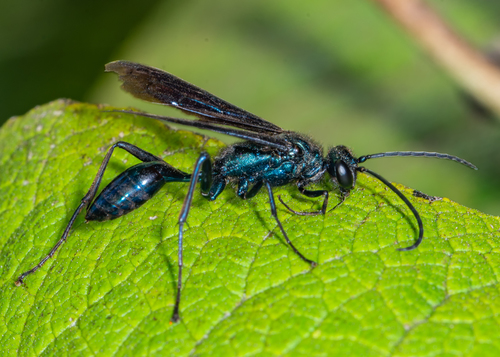
Common Blue Mud-dauber Wasp
Chalybion californicum
A shimmering jewel of the insect world, the Common Blue Mud-dauber is a non-aggressive solitary wasp famous for its metallic blue armor and its role as a natural controller of garden spiders.
Quick Identification
Size
12 to 22 mm (0.47 to 0.87 inches) in length
Colors
Brilliant metallic blue or blue-green sheen over a dark body; wings are translucent with a dark smoky tint.
Key Features
- Slender 'thread-waist' (petiole) connecting thorax and abdomen
- Striking metallic blue or blue-black iridescence
- Dark, smoky-colored wings
- Active, nervous movement with frequent wing-flicking
When You’ll See Them
Geographic range
Where Does the Common Blue Mud-dauber Wasp Live?
The Common Blue Mud-dauber is native to the North American continent, maintaining a massive footprint that stretches from southern Canada across nearly the entire United States and deep into Mexico. It is a highly adaptable species found in almost every state, though it is most prolific in regions with temperate or subtropical climates. Beyond its native range, this wasp has been introduced to Hawaii, Bermuda, and parts of the Mediterranean, including Croatia, where it has successfully established local populations. Because it thrives in human-altered landscapes, it is one of the most widely distributed and easily spotted wasps in residential areas across the continent.
Basemap © OpenStreetMap contributors
Behavior
The Common Blue Mud-dauber is a solitary wasp known for its striking appearance and specialized nesting habits. Unlike social wasps, they do not live in colonies or defend a central hive, making them remarkably docile and unlikely to sting humans unless directly handled. They are famous for being 'squatters'; instead of building their own mud nests from scratch, they often take over the abandoned or active nests of Black-and-yellow Mud-daubers. They use water to soften the mud of these existing nests, reshape them, and then re-seal them after provisioning.
These wasps are highly active during the warmest parts of the day. You will often see them around puddles or garden hoses, where they collect water to transport back to their nesting sites. They are also exceptional hunters with a very specific menu: spiders. A female will paralyze a spider with a precise sting and stuff it into a nest cell, eventually filling the chamber with several spiders to serve as a fresh food source for her developing larvae.
EverydayEarth exclusive
Camera Tips
To capture high-quality footage of the Common Blue Mud-dauber, you need to focus on three primary 'hotspots': water sources, nectar-rich flowers, and mud nests. These wasps are frequently seen landing on the edges of puddles or birdbaths to collect water. Set your camera on a tripod at a low angle near a damp patch of soil or a shallow water feature. Because these insects are small and fast, a macro lens or a camera with a dedicated macro mode is essential to capture the metallic detail of their exoskeleton.
Placement near eaves, porch ceilings, or the undersides of bridges is another winning strategy. Look for the cylindrical mud tubes built by other wasps; the Blue Mud-dauber will visit these frequently to renovate them. Position your camera about 12-18 inches away from the nest. Use a high frame rate (at least 60fps) if possible, as their wing movements and 'tail-wagging' behavior are very rapid. Since they are most active in full sun, you won't need artificial lighting, but ensure the nest site isn't in deep, grainy shadow.
If you want to bait them into your camera's field of view, plant white-flowering herbs like Queen Anne's Lace, Dill, or Fennel. These wasps have short mouthparts and prefer flat, open flowers where nectar is easily accessible. Place your camera at flower-height, roughly 1 to 2 feet away, and use a fast shutter speed to freeze their frantic flight patterns. Early afternoon on a bright, windless day is the peak window for capturing their most vibrant blue colors as the sun hits their iridescent bodies.
Frequently Asked Questions
Record Common Blue Mud-dauber Wasp at your habitat
Connect a camera to start building your own species record — AI identifies every visitor automatically.