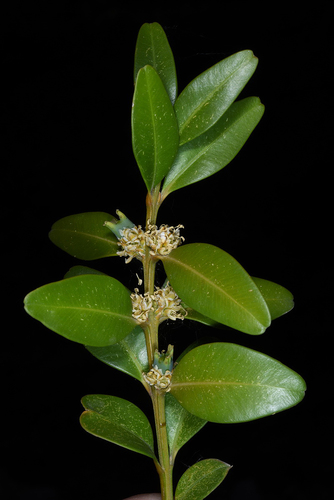
common box
Buxus sempervirens
The backbone of the classic garden, Common Box is more than just a hedge—it's a year-round sanctuary for the most secretive backyard visitors.
Quick Identification
Size
A slow-growing shrub or small tree typically reaching 1-5 meters (3-16 feet) in height, though legacy specimens can reach 9 meters (30 feet).
Colors
Glossy dark green leaves on top, pale yellow-green underneath; small, petal-less yellow-green flowers.
Key Features
- Dense, evergreen foliage that remains vibrant through winter
- Small, oval, leathery leaves (1.5–3 cm long) arranged in opposite pairs
- Squared stems on new growth that become rugged and corky with age
- Inconspicuous clusters of yellow-green flowers appearing in spring
- A distinct, musky scent particularly noticeable after rain or when leaves are crushed
When You’ll See Them
Loading activity data...
Behavior
Common box is a foundational species in many ecosystems and gardens, serving as a "silent provider" for backyard wildlife. While it does not move or forage, its dense growth habit provides essential structural complexity. It acts as a primary nesting site for small songbirds and a winter thermal refuge for insects and small mammals. In the wild, it is remarkably shade-tolerant, often growing in the understory of beech or oak forests.
Humans have interacted with the common box for centuries, utilizing its incredibly hard, fine-grained wood for engraving and musical instruments. In modern backyards, it is the gold standard for topiary and hedging. However, it is a toxic plant if ingested by pets or humans, containing alkaloids that serve as a natural defense against many herbivores, though some specialized insects have evolved to thrive on it.
EverydayEarth exclusive
Camera Tips
While common box is stationary, it is one of the most strategic locations to place a backyard camera because it acts as a 'wildlife hub.' The dense interior of a box shrub is a favorite hiding spot for small birds like wrens and dunnocks, and a hunting ground for spiders and predatory insects. Position your camera about 2 to 3 feet away from the foliage, aimed at a 'gateway' or opening in the leaves where you see birds entering and exiting. This 'stage-style' setup captures high-activity behavior that occurs when animals feel safe under cover.
Because boxwood is evergreen, it is the perfect subject for winter time-lapse photography. Set your camera to take a photo once every hour throughout the winter months to capture the subtle ways the plant interacts with snow and ice, or how birds utilize it as a thermal windbreak during storms. If you are specifically looking for the Box Tree Moth—a major pest of this plant—set your camera to macro mode and focus on the underside of the leaves where caterpillars congregate, using a trigger sensitivity set to high.
For the best lighting, avoid placing the camera where it faces directly into the sun through the leaves, as the glossy surface of the boxwood can cause significant lens flare and 'blow out' your images. Instead, aim for a north-facing angle or use the plant's own shadow to provide a consistent, even light for the sensor. If you are using an AI-powered camera, the dense green background of the boxwood provides an excellent high-contrast canvas that helps the AI more easily identify colorful birds like Northern Cardinals or Blue Jays as they perch on the outer branches.
Similar Species
Species that look similar or are commonly confused with common box.
Japanese Box
Smaller, more rounded leaves and a more compact, spreading growth habit than the common box.
European Yew
Has needle-like leaves rather than broad oval leaves, and produces red berry-like arils instead of dry capsules.
Privet
Faster growing with thinner, more flexible leaves that often drop in cold winters unlike the leathery, evergreen box.
Frequently Asked Questions
Record common box at your habitat
Connect a camera to start building your own species record — AI identifies every visitor automatically.