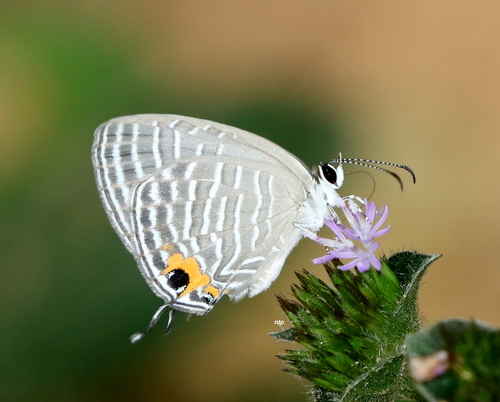
Common Cerulean
Jamides celeno
A fluttering gem of the Indomalayan tropics, the Common Cerulean delights observers with its milky-blue wings and intricate, wavy-patterned underside. This adaptable little butterfly is a master of the garden, turning every damp patch and flowering shrub into a stage for its graceful dance.
Quick Identification
Size
Wingspan of 27–40 mm (1.1–1.6 inches)
Colors
Pale milky-blue to iridescent white upperside with thin black borders; underside is grayish-brown with distinct white wavy bands and an orange-crowned eyespot.
Key Features
- Wavy white bands on the underside of wings
- Single orange-rimmed eyespot near the tail
- Delicate, hair-like tail on the hindwing
- Pale blue upperside visible in flight
When You’ll See Them
Geographic range
Where Does the Common Cerulean Live?
The Common Cerulean is native to the vast Indomalayan realm, stretching across South and Southeast Asia. Its core range includes the Indian subcontinent, Sri Lanka, and Myanmar, extending through the Malay Peninsula to the islands of Indonesia and the Philippines. This adaptable species thrives in both pristine forest edges and heavily modified urban landscapes across the tropical and subtropical regions of the continent.
Basemap © OpenStreetMap contributors
Behavior
The Common Cerulean is a lively and energetic butterfly known for its erratic, low-to-the-ground flight patterns. Unlike many of its bolder relatives, it often prefers the dappled light found near the shade of shrubs or the lower canopy of trees. It is a frequent visitor to backyard gardens, where it moves quickly between flowers, rarely staying in one spot for long unless feeding or egg-laying.
One of its most characteristic behaviors is 'puddling,' where groups of these butterflies congregate on damp soil, mud, or wet sand. This allows them to extract essential minerals and salts that are vital for reproduction. While they are active during sunny periods, they are also known to remain active during light overcast conditions, unlike many other butterfly species that require direct heat to fly.
EverydayEarth exclusive
Camera Tips
To capture the Common Cerulean on an AI-powered backyard camera, focus your lens on specific 'micro-habitats' rather than wide-open spaces. Position your camera about 2 to 3 feet off the ground, angled slightly downward toward a cluster of nectar-rich flowers like Lantana or Ixora. Because these butterflies are quite small, ensure your camera is positioned within its minimum focus distance (usually 18–24 inches) to ensure the AI can clearly identify the wing patterns.
One of the most effective ways to lure this species is by creating a 'puddling station.' Use a shallow tray filled with wet sand and a tiny pinch of sea salt or a few drops of compost tea. Place this station in a spot that receives filtered morning sunlight. The Common Cerulean is highly attracted to these mineral sources, often staying still for several minutes, which provides the perfect opportunity for high-resolution captures.
Lighting is critical for photographing the Cerulean's delicate features. Avoid placing the camera in harsh, direct midday sun, which can overexpose the white bands on their underside. Dappled light under a tree or the soft light of early morning (9 AM to 11 AM) will highlight the iridescent blue of their upperside when they open their wings. If your camera has a 'pro' mode, use a high shutter speed to capture their rapid wing beats without blur.
Finally, identify any host plants in your yard, such as Rattlepods (Crotalaria) or various leguminous trees. Female Ceruleans will hover slowly around the fresh new growth or flower buds of these plants to lay eggs. Setting your camera to trigger on movement in these specific zones will significantly increase your chances of capturing unique egg-laying behaviors.
Similar Species
Species that look similar or are commonly confused with Common Cerulean.
Frequently Asked Questions
Record Common Cerulean at your habitat
Connect a camera to start building your own species record — AI identifies every visitor automatically.