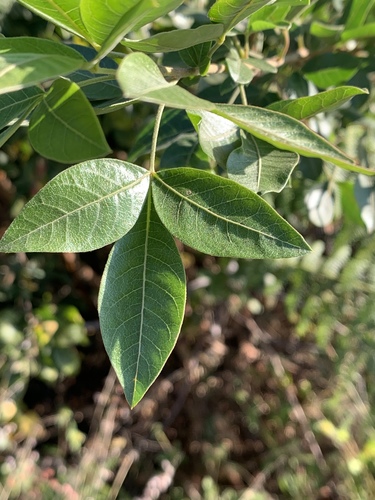
Common currant-rhus
Searsia pyroides
A hardy, bird-attracting powerhouse of the African landscape, the Common currant-rhus is a must-have for any wildlife-friendly garden.
Quick Identification
Size
Typically 3–6 metres (10–20 feet) in height, though it can occasionally reach 8 metres (26 feet).
Colors
Dull green to olive foliage; young leaves are often tinged with red; fruits turn from green to a dark, dull red or burgundy when ripe.
Key Features
- Trifoliate leaves with three distinct leaflets
- Woody, spine-tipped branchlets (thorns)
- Small, pea-sized edible berries in heavy clusters
- Fine, velvety hairs usually covering the stems and leaves
When You’ll See Them
Behavior
The Common currant-rhus is a hardy, deciduous to semi-deciduous tree known for its resilience and its role as a cornerstone of the backyard ecosystem. It often grows as a multi-stemmed shrub or a small, spreading tree with a rounded crown. During the flowering season, it produces inconspicuous yellow-green blooms that, while small, are a major draw for pollinating insects. As the fruit ripens, the tree becomes a hub of activity for various bird species and small mammals.
In a garden setting, this species is highly valued for its ability to provide thick cover and nesting sites, thanks to its dense growth habit and protective thorns. It is remarkably tough, capable of surviving both heavy frosts and periods of drought, making it a reliable presence in changing climates. While it doesn't 'behave' in the animal sense, its seasonal transitions—from the flush of new red-tinted leaves in spring to the heavy fruiting in summer—dictate the rhythm of the wildlife that visits it.
EverydayEarth exclusive
Camera Tips
Capturing wildlife on the Common currant-rhus requires focusing on the tree as a destination rather than a subject. During the mid-to-late summer months when the berries (currants) are ripe, mount your camera directly onto a sturdy branch or use a nearby tripod angled toward a cluster of fruit. This is the 'hot zone' for bird activity, attracting bulbuls, barbets, and mousebirds. A fast shutter speed or high-frame-rate video setting is essential to catch the rapid movements of these birds as they feast.
For ground-dwelling visitors, place your camera about 30–50 cm (12–20 inches) off the ground, aimed at the base of the trunk. Many small mammals, such as mongooses or even small antelope in more rural areas, will visit the tree to scavenge fallen fruit or browse the lower foliage. If your camera has a macro or close-focus mode, use it to capture the intricate details of the pollinators, like butterflies and honeybees, that swarm the tiny flowers in early summer.
Because this tree often grows in dense thickets, lighting can be a challenge. Try to position your camera so the sun is behind it, illuminating the fruit clusters. If the canopy is too thick, you may need to use a gentle flash or rely on the camera's high ISO capabilities. Since the tree is stationary, you have the luxury of time to experiment with different angles—try a 'worm's eye view' looking up through the branches to capture birds silhouetted against the sky.
Similar Species
Species that look similar or are commonly confused with Common currant-rhus.
Frequently Asked Questions
Record Common currant-rhus at your habitat
Connect a camera to start building your own species record — AI identifies every visitor automatically.