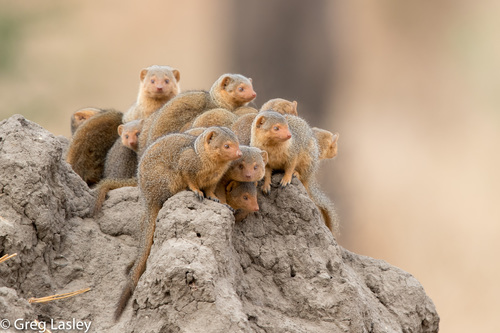
Common Dwarf Mongoose
Helogale parvula
Africa's smallest carnivore is a social powerhouse that turns termite mounds into bustling miniature cities. These charismatic hunters are famous for their teamwork, 'talking' to each other with a complex series of chirps as they forage.
Quick Identification
Size
Body length 18-28 cm (7-11 in); Tail length 14-19 cm (5.5-7.5 in); Weight 210-350 g (7.4-12.3 oz)
Colors
Variable from yellowish-red to dark brown with a grizzled texture; underparts are usually lighter and feet/tail tip are slightly darker.
Key Features
- Smallest carnivore in Africa
- Social groups often traveling in single file
- Pointed muzzle with small, rounded ears
- Association with large termite mounds
When You’ll See Them
Sightings on EverydayEarth
Jun 22, 2026
A social group of several Common Dwarf Mongooses is active in a dry, grassy clearing. They are seen scurrying around a small mound, likely a termite mound, and foraging through the dry vegetation.
Geographic range
Where Does the Common Dwarf Mongoose Live?
Native to the African continent, the Common Dwarf Mongoose occupies a vast territory across Eastern and Southern Africa. Their core range extends from Ethiopia and Somalia in the north, sweeping down through Kenya and Tanzania into South Africa, and reaching westward into Namibia and Angola. While they are resilient across many landscapes, they avoid the dense rainforests of Central Africa and the most extreme, waterless deserts.
Basemap © OpenStreetMap contributors
Behavior
Common Dwarf Mongooses are highly social animals that live in stable groups of 5 to 30 individuals. Their society is matriarchal, led by a dominant breeding female and her subordinate mate. Interestingly, this species practices cooperative breeding, where lower-ranking members of the group help clean, protect, and feed the alpha female's pups. They are strictly diurnal, spending their days foraging for insects and returning to the safety of termite mounds or rock crevices at night.
These little hunters have a fascinating mutualistic relationship with certain birds, specifically hornbills. The hornbills follow the mongooses while they forage, snatching up insects stirred up by the mammals. In return, the hornbills act as sentinels, giving alarm calls to warn the mongooses of approaching birds of prey. In suburban environments near their natural range, they are relatively bold but will quickly vanish into cover if they feel threatened by pets or humans.
EverydayEarth exclusive
Camera Tips
To capture the Common Dwarf Mongoose, the golden rule is to locate a termite mound. These structures serve as their primary apartments, nurseries, and lookout posts. Position your camera about 10-15 feet from an active mound, but keep the lens height very low—no more than 6 inches (15 cm) off the ground. Because they are so small, a standard chest-high camera placement will only capture the tops of their heads and miss the social interactions that make them so interesting.
Use a high-speed trigger and set your camera to burst mode or short video clips. Dwarf Mongooses move in quick, jerky bursts of energy, and they often travel in a 'train' where one follows another. A single photo might catch one individual, but a 10-second video will likely reveal the entire family group passing by. Since they are diurnal, you don't need to worry about heavy flash, but ensure your camera is positioned to avoid direct morning or evening sun flares, as they are most active during these 'golden hours.'
Avoid using meat-based baits, as these might attract larger predators that would scare the mongooses away. Instead, if you are on a private property where it is permitted, a small dish of water in a dry area can be a powerful magnet. They are incredibly inquisitive; sometimes placing a novel, non-threatening object like a flat stone or a hollow log in the frame will encourage them to stop and investigate, giving you a perfect still shot.
Similar Species
Species that look similar or are commonly confused with Common Dwarf Mongoose.
Frequently Asked Questions
Record Common Dwarf Mongoose at your habitat
Connect a camera to start building your own species record — AI identifies every visitor automatically.