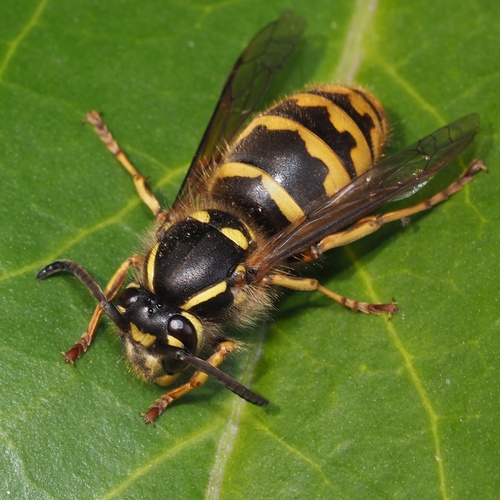
Common European Yellowjacket
Vespula vulgaris
Meet the master architect of the backyard. The Common European Yellowjacket is a social powerhouse, building papery cities and providing essential pest control for gardeners across the globe.
Quick Identification
Size
Workers: 12–17 mm (0.5–0.7 in); Queen: 20 mm (0.8 in); Wingspan: 25–35 mm (1–1.4 in)
Colors
Bold alternating bands of bright yellow and black. Most individuals feature a distinctive black 'anchor' or 'dagger' shaped mark on the yellow face (clypeus).
Key Features
- Black anchor-shaped mark on the yellow face
- Distinctive narrow 'wasp waist'
- Two pairs of smoky wings that fold lengthwise when at rest
When You’ll See Them
Geographic range
Where Does the Common European Yellowjacket Live?
Native to the Palearctic region, the Common European Yellowjacket is found throughout Europe, North Africa, and temperate parts of Asia. It has successfully established large invasive populations in New Zealand and Australia, where the lack of harsh winters allows for massive, multi-year nests. In its core range, it is a ubiquitous presence in both wild forests and bustling human settlements.
Basemap © OpenStreetMap contributors
Behavior
Common European Yellowjackets are highly social insects that live in complex colonies centered around a single queen. They are famous for their intricate nests made from chewed wood fibers mixed with saliva, resulting in a grey, papery material. These nests are often hidden underground in abandoned rodent burrows or tucked away in wall cavities and attic spaces. Within these structures, a single colony can house thousands of industrious workers throughout the summer months.
As the season progresses, their social dynamics and interactions with humans change significantly. In the spring and early summer, workers are focused on gathering protein to feed the developing larvae. By late summer and autumn, the colony's focus shifts to sustaining the queen and new reproductive individuals. This is when they become most noticeable to humans, as they scavenge aggressively for sugary foods and fallen fruit to fuel their high-energy flight.
While they are often viewed as pests due to their defensive nature, they are actually beneficial to gardeners. They act as natural pest controllers, hunting a wide variety of garden insects including caterpillars, flies, and spiders. However, they are fiercely protective of their home; if a nest is disturbed, workers will release alarm pheromones that signal the rest of the colony to defend the site with repeated stings.
EverydayEarth exclusive
Camera Tips
To capture high-quality footage of the Common European Yellowjacket, timing and bait selection are everything. In late summer (August and September), these insects are highly attracted to sweets. Place a shallow dish of jam, honey-water, or overripe fruit like peaches or grapes on a flat surface. This will create a 'feeding station' that keeps them stationary long enough for the camera to focus on their intricate markings.
Position your camera very close to the bait—ideally between 12 and 18 inches away. Since yellowjackets are small, use a macro lens or ensure your AI-powered camera is set to its closest focal point. Angle the camera so the sun is behind it; this illuminates the translucent wings and the bright yellow bands, preventing the subject from appearing as a dark silhouette.
Because yellowjackets move with rapid, erratic flight patterns, set your camera to its highest possible frame rate or shutter speed. This is essential for freezing the motion of their wings. If using a motion-triggered camera, set the sensitivity to high, as the small body mass of a single wasp may not always trigger lower-sensitivity infrared sensors.
Safety is a priority when setting up equipment. Avoid placing cameras directly at a nest entrance, as the high traffic and defensive behavior of the colony can lead to stings. Instead, focus on foraging areas. If you are filming near a nest, wear light-colored clothing and move slowly, as dark, vibrating objects are often perceived as threats by the colony.
Similar Species
Species that look similar or are commonly confused with Common European Yellowjacket.
Frequently Asked Questions
Record Common European Yellowjacket at your habitat
Connect a camera to start building your own species record — AI identifies every visitor automatically.