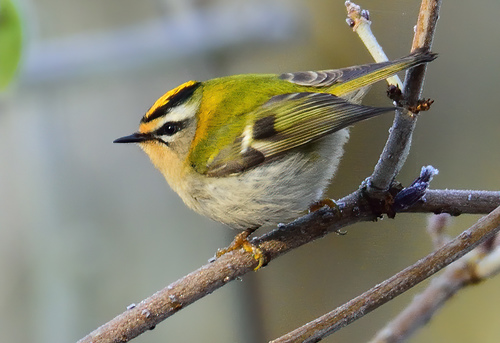
Common Firecrest
Regulus ignicapilla
Meet the Common Firecrest, a tiny, high-energy jewel of the European canopy. With its brilliant 'fire' crown and striking masked face, this feathered dynamo is a master of acrobatic flight and a prize for any backyard observer.
Quick Identification
Size
Length: 9 cm (3.5 in); Wingspan: 13–16 cm (5–6 in); Weight: 4–7 g (0.14–0.25 oz)
Colors
Bright olive-green upperparts, off-white underparts, and distinct bronze shoulder patches. Males feature a fiery orange-red crown, while females have a bright yellow crown.
Key Features
- Vivid orange or yellow crest bordered by black
- Bold white eyebrow (supercilium) and black eye-stripe
- Bronze-colored patch on the side of the neck
- Tiny, compact body with a restless, hovering flight style
When You’ll See Them
Geographic range
Where Does the Common Firecrest Live?
The Common Firecrest is a native resident across much of temperate Europe and reaches into the high-altitude cedar forests of Northwest Africa. From the coastal gardens of the United Kingdom and France to the vast forests of Germany and Poland, this species is a staple of the Western Palearctic. While many southern populations remain in their territories year-round, birds from the colder regions of Central Europe are partial migrants, moving south and west to find milder climates during the winter months.
Basemap © OpenStreetMap contributors
Behavior
The Common Firecrest is a bird of perpetual motion, characterized by its restless energy and acrobatic foraging style. Unlike many woodland birds that stay hidden, the Firecrest is often seen flitting between the outermost twigs of conifers and broadleaf trees, frequently hovering for a few seconds to snatch tiny insects from the undersides of leaves. They are highly vocal birds, though their high-pitched, rhythmic calls are so thin and sharp they can sometimes be difficult for human ears to detect amidst the rustle of the wind.
In the breeding season, the male Common Firecrest is a dramatic performer. To defend his territory or attract a mate, he will puff out his fiery crest into a brilliant, fan-like mohawk while tilting his head toward his rival. Despite their tiny size, they are bold and relatively approachable, often continuing their frantic search for food just a few feet away from an observer. During the winter, they are social creatures, often joining 'roving tit flocks' where they forage alongside Blue Tits, Coal Tits, and Goldcrests for safety in numbers.
EverydayEarth exclusive
Camera Tips
Capturing the Common Firecrest on a backyard camera requires a focus on their specific vertical habits. These birds are canopy specialists, meaning they spend 90% of their time high in the trees. To bring them within range of your lens, you must provide a reason for them to descend. A elevated bird bath—ideally one with a solar-powered fountain or a 'dripper'—is the most effective lure. Firecrests are highly attracted to the sound of moving water and will often descend to a high-perched basin to bathe and drink, especially during dry spells or in the middle of winter.
Because the Common Firecrest is one of the smallest birds in the world, standard motion-sensing triggers on trail cameras can be hit-or-miss. Set your camera’s PIR sensitivity to the 'High' or 'Ultra' setting to ensure it detects their tiny bodies. Furthermore, these birds never stay still; they are constantly twitching their wings and hopping. To avoid a gallery of blurry green streaks, use a camera with a fast shutter speed or a specific 'Bird Mode.' If your camera allows for it, setting a 'Burst Mode' to take 3-5 photos per trigger will significantly increase your chances of getting that one perfect shot with the crest fully visible.
Placement is everything. Mount your camera 4-6 feet off the ground, angled toward a specific 'landing branch' near your water source or a cluster of evergreen foliage like Yew or Ivy. These plants are magnets for the tiny insects Firecrests eat. Aim for a North-facing orientation to ensure the lighting is soft and even; harsh direct sunlight can wash out the delicate white and black facial markings that distinguish the Firecrest from its cousin, the Goldcrest. During the winter, placing your camera near a suet feeder might occasionally catch them, but they aren't traditional seed-eaters—they are there for the insects the suet attracts!
Similar Species
Species that look similar or are commonly confused with Common Firecrest.
Frequently Asked Questions
Record Common Firecrest at your habitat
Connect a camera to start building your own species record — AI identifies every visitor automatically.