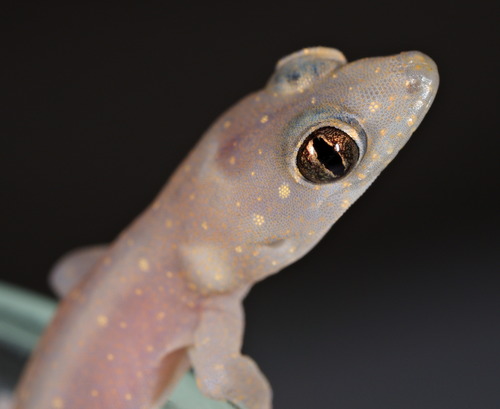
Common Four-clawed Gecko
Gehyra mutilata
Often called the 'Sugar Gecko' for its pale, sweet appearance, this delicate climber is a master of the night. Watch as it patrols your patio walls, using the glow of your porch light to hunt for its next meal.
Quick Identification
Size
Total length of 10–12 cm (4–4.7 inches); snout-to-vent length of about 5–6 cm (2–2.4 inches)
Colors
Soft pinkish-gray or purplish-tan with a translucent appearance; juveniles feature golden spots that fade with age; underside is creamy white or pale yellow.
Key Features
- Clawless or stump-like inner toe on each foot
- Translucent, delicate-looking skin that tears easily
- Flattened tail with small serrated edges
- Large, lidless eyes with vertical slit pupils
When You’ll See Them
Geographic range
Where Does the Common Four-clawed Gecko Live?
Native to the tropical heart of Southeast Asia, the Common Four-clawed Gecko has become a prolific world traveler. From its ancestral homes in Indonesia, the Philippines, and Thailand, it has expanded its presence across the Pacific Islands, including Hawaii and various Polynesian archipelagos. This adaptable reptile has also established successful introduced populations in coastal regions of North America, notably in Florida and Mexico, as well as parts of Australia and Sri Lanka.
Basemap © OpenStreetMap contributors
Behavior
The Common Four-clawed Gecko is a nocturnal specialist known for its incredible ability to coexist with humans. Unlike many shy reptiles, this species, often called the "Sugar Gecko," is frequently found patrolling the walls and ceilings of suburban homes. They are highly opportunistic hunters that have learned to use artificial light to their advantage, waiting patiently near outdoor lamps for insects to be drawn into striking range. Their movement is characterized by short, quick bursts of speed followed by long periods of absolute stillness.
Socially, they are somewhat more tolerant than other house geckos, though males will still defend prime hunting spots near lights. One of their most unique and startling behaviors is their defense mechanism; if grabbed by a predator, their skin is remarkably fragile and can tear away entirely, allowing the gecko to escape while the predator is left with nothing but a mouthful of skin. They also possess the ability to vocalize, producing a series of soft clicking or chirping sounds during social interactions or territorial disputes.
EverydayEarth exclusive
Camera Tips
To capture high-quality footage of the Common Four-clawed Gecko, position your camera near an outdoor light source, such as a porch light or a security lamp. These geckos are "sit-and-wait" predators that congregate where insects are most abundant. For the best angle, mount the camera 5 to 7 feet high on a vertical wall or fence post, aiming it toward a flat surface where the gecko can be seen in profile. Because they are relatively small, a camera with a close-focusing or macro lens capability will yield the best results.
Since these geckos are strictly nocturnal, ensure your camera has a high-quality infrared (IR) night vision mode. While white-light flash can capture their subtle pinkish hues, it may startle the gecko and cause it to flee. Setting your camera to record short video clips (10–20 seconds) is more effective than still photos, as it captures their unique hunting lunges and social chirping. If you want to attract them specifically to a camera zone, you don't need food bait; instead, use a small UV light or "bug light" to draw in the moths and flies they crave.
Be mindful of the weather when placing your gear. While these geckos love humidity, they are most active on warm, still nights. High winds can keep them tucked into crevices. Check your camera housing for small gaps; these "tender-skinned" geckos are surprisingly curious and may try to squeeze into the camera casing itself if it offers a warm spot near the battery or processor!
Frequently Asked Questions
Record Common Four-clawed Gecko at your habitat
Connect a camera to start building your own species record — AI identifies every visitor automatically.