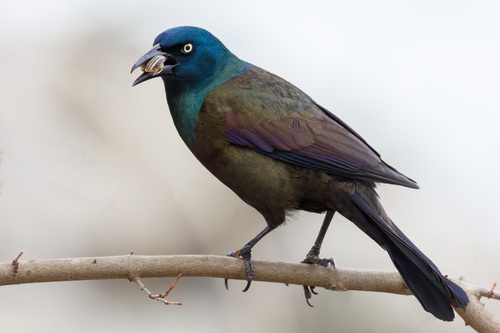
Common Grackle
Quiscalus quiscula
With their piercing yellow eyes and shimmering iridescent plumage, Common Grackles are the bold characters of the backyard. These resourceful songbirds bring a touch of metallic brilliance and boisterous energy to every garden they visit.
Quick Identification
Size
Length 28-34 cm (11-13.4 in); wingspan 36-46 cm (14-18 in); weight 74-142 g (2.6-5.0 oz)
Colors
Adult males are iridescent black with a glossy purple or blue head and bronze or purple sheen on the body. Females are less iridescent, appearing brownish-black. Both have striking pale yellow eyes.
Key Features
- Bright, pale yellow eyes contrast with dark plumage
- Long, wedge-shaped tail that appears V-shaped or 'keeled' in flight
- Iridescent metallic sheen on head and neck
- Thick, slightly curved dark bill
When You’ll See Them
Sightings on EverydayEarth
Mar 17, 2026
A diverse group of birds congregates at the feeding station on a bright day. On the suet feeders to the left, a Red-bellied Woodpecker and a speckled European Starling take turns feeding. The main platform is crowded with Common Grackles and Red-winged Blackbirds. In the background, the partially frozen waters of the pond reflect the afternoon sun.
Aug 1, 2026
The scene is active with several birds visiting the feeder station. A male Downy Woodpecker is initially perched on the center feeder before departing. Shortly after, two Common Grackles land on the main tray to forage. A Brown-headed Cowbird is also seen feeding on the log-style suet feeder on the left, while another grackle perches above the station.
Aug 1, 2026
The video captures a busy morning at the feeder. A Downy Woodpecker is seen clinging to the suet feeder on the left, while a White-throated Sparrow and a Common Grackle forage on the main seed tray. Around the seven-second mark, a Blue Jay swoops in and lands on the tray, causing the other birds to depart. The Blue Jay then begins to sift through the seeds.
Aug 1, 2026
A busy morning at the feeder features several male Red-winged Blackbirds foraging in the tray and on the ground. Two Downy Woodpeckers are also present, one clinging to the central wooden support and another on a tree trunk to the left. A Common Grackle is perched on the cylindrical seed feeder on the right side of the frame.
Aug 1, 2026
A diverse group of birds is active at the feeder station during the early morning. A male Downy Woodpecker works on the log feeder while a male Red-winged Blackbird, showing its vibrant shoulder patches, feeds on the tray alongside several streaked females. A Common Grackle and a European Starling also compete for food in the center, while a male House Finch visits the tube feeder on the right. The birds are busy and constantly moving between the different food sources.
Jul 31, 2026
A high-activity morning at the feeder station. Several male Red-winged Blackbirds are feeding across the tray and suet blocks, displaying their bright shoulder patches. They are joined by Common Grackles, creating a busy scene as the birds compete for positions at the various seed and suet dispensers.
Geographic range
Where Does the Common Grackle Live?
Native to the North American continent, the Common Grackle is found extensively throughout the United States and southern Canada east of the Rocky Mountains. They are particularly abundant in the Great Plains and the eastern seaboard, with their range extending from the edge of the boreal forests in the north down to the Gulf Coast and Florida. While they are year-round residents in the central and southern parts of their range, northern populations are migratory, pushing south as winter temperatures drop to join massive communal roosts.
Basemap © OpenStreetMap contributors
Recorded on EverydayEarth
Behavior
Common Grackles are highly social and intelligent birds, often seen in large, boisterous flocks, especially during the fall and winter when they may congregate with other blackbirds and starlings by the thousands. They are bold foragers, often striding across lawns with a purposeful gait, scanning for insects or seeds. In suburban environments, they are frequent visitors to bird feeders, where their assertive nature and larger size often allow them to dominate smaller songbirds.
One of their most fascinating behaviors is 'anting,' where they allow ants to crawl through their feathers or rub crushed ants on their plumage to utilize the formic acid as a natural pesticide against mites. They are also known for their wide-ranging vocalizations, which include a variety of squeaks, rattles, and a signature metallic 'clink' that sounds somewhat like a rusty gate hinge opening. During the breeding season, males puff out their feathers and spread their tails in an impressive display to attract mates.
EverydayEarth exclusive
Camera Tips
To capture the best footage of Common Grackles, focus your camera on the ground. Unlike many songbirds that prefer hanging feeders, grackles are natural ground-foragers. Position your AI-powered camera 6 to 12 inches off the ground near a patch of open lawn or under an existing bird feeder. This low angle will highlight their confident 'strut' and capture the impressive length of the male's keeled tail as it drags through the grass.
Water is an incredible lure for this species. Grackles are frequent and enthusiastic bathers. If you have a shallow bird bath or a backyard water feature, aim your camera there. To get the clearest shots, place the camera on the north side of the water source so the sun is behind the lens; this lighting is essential to reveal the hidden blues, purples, and bronzes in their iridescent feathers, which often look flat black in shadows or harsh overhead light.
In terms of bait, Common Grackles are not picky, but they are particularly fond of cracked corn, suet, and black oil sunflower seeds. Using a flat platform feeder or simply scattering seed on a flat rock will keep them in the frame longer than a tube feeder would. Because they are social, you are likely to capture multiple birds at once, so set your camera to a wide-angle view if possible.
For settings, prioritize a fast trigger speed and burst mode. Grackles are jerky, fast-moving birds that constantly scan their surroundings. A video setting of 30 or 60 fps will help you catch their quick head movements and the 'puffing' displays of the males during the spring. Early morning and late afternoon offer the best 'golden hour' light to make their metallic plumage truly pop against a green backyard background.
Similar Species
Species that look similar or are commonly confused with Common Grackle.
European Starling
Smaller with a much shorter tail, dark eyes, and a different walking gait compared to the grackle's long-tailed strut.
Boat-tailed Grackle
Larger with an even more oversized tail; primarily found in coastal salt marshes rather than inland suburbs.
Brown-headed Cowbird
Much smaller with a shorter, thicker beak and a distinct brown head on the males, lacking the grackle's bright yellow eyes.
Frequently Asked Questions
Record Common Grackle at your habitat
Connect a camera to start building your own species record — AI identifies every visitor automatically.