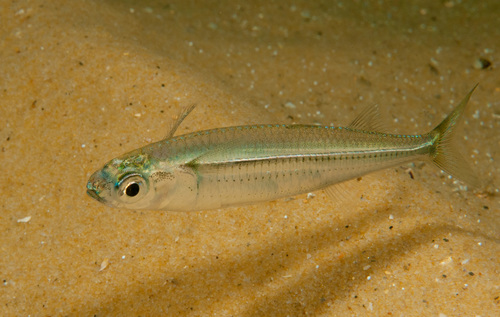
Common Hardyhead
Atherinomorus vaigiensis
A shimmering sentinel of the shallows, the Common Hardyhead moves in dazzling, synchronized schools across the Indo-Pacific. These silver-striped beauties are the heartbeat of coastal estuaries and reef flats.
Quick Identification
Size
Typically 10-15 cm (4-6 inches) in length; rarely exceeds 17 cm (6.7 inches).
Colors
Translucent greenish or brownish upper body with a distinct, broad silvery-blue band along the sides; silvery-white belly.
Key Features
- Slender, torpedo-shaped body
- Two widely separated dorsal fins
- Wide, silvery mid-lateral stripe
- Short, blunt snout with a relatively large mouth
When You’ll See Them
Geographic range
Where Does the Common Hardyhead Live?
The Common Hardyhead is a wide-ranging resident of the Indo-West Pacific region. Its territory stretches from the Red Sea and the eastern coast of Africa across to the Line Islands, encompassing much of the tropical waters of Southeast Asia. It is particularly abundant along the northern coasts of Australia and reaches as far north as the subtropical waters of southern Japan. In these regions, it remains a common fixture of near-shore marine ecosystems.
Basemap © OpenStreetMap contributors
Behavior
The Common Hardyhead is a highly social, schooling fish that spends the majority of its time in large, dense groups near the water's surface. These schools act as a defense mechanism against predators, with the shimmering silver bodies creating a 'flash' effect that confuses hunters. They are exceptionally agile and can dart away at high speeds when startled by movement or shadows.
In coastal areas, they are frequently seen around man-made structures like jetties, piers, and boat ramps, where they find refuge from larger fish. While they are not known for complex social hierarchies, their synchronized swimming patterns are a marvel of natural coordination. They show little fear of humans if approached slowly, often allowing snorkelers or underwater cameras to get quite close before moving as a single unit.
EverydayEarth exclusive
Camera Tips
Capturing the Common Hardyhead requires an underwater camera setup, such as an action camera in a waterproof housing or a dedicated submersible trail cam. For the best results, mount your camera to a fixed structure like a jetty pylon or a weighted tripod placed in shallow water (under 2 meters). Position the lens to face slightly upward toward the surface or toward the open water just off a structure to catch the school as they pass through the light.
Lighting is your biggest challenge. Because Hardyheads are highly reflective, direct sunlight in very shallow water can cause 'blown-out' highlights on their silvery scales. Aim to record during the mid-morning or late afternoon when the light is softer. If you are using a camera with adjustable settings, a fast shutter speed is essential to freeze their rapid movements and prevent motion blur within the school.
To attract a school to your camera's field of view, you can use a small amount of finely ground fish meal or breadcrumbs in a mesh bait bag. However, Hardyheads are naturally curious about new objects in their environment. Often, simply leaving the camera stationary for 20 minutes will allow the school to acclimate and begin swimming naturally around the device. Ensure your housing is clean and free of salt spots, as the silver stripe of the Hardyhead will highlight any lens imperfections.
Frequently Asked Questions
Record Common Hardyhead at your habitat
Connect a camera to start building your own species record — AI identifies every visitor automatically.