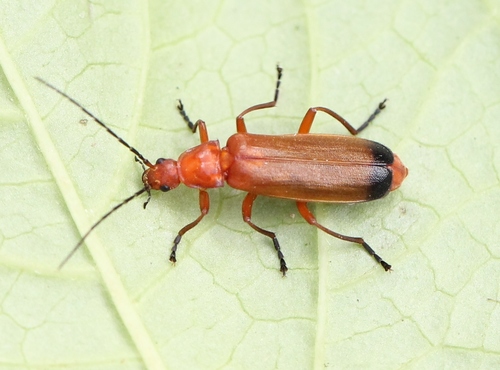
Common Red Soldier Beetle
Rhagonycha fulva
The Common Red Soldier Beetle is a bright summer icon of the backyard garden, easily identified by its orange-red body and black-tipped wings. A dual-purpose ally, it helps pollinate your flowers while preying on pesky aphids.
Quick Identification
Size
7–10 mm (0.28–0.39 inches) in length
Colors
Bright orange-red body with distinctive black patches at the tips of the wing cases (elytra); legs and antennae are mostly dark or black.
Key Features
- Elongated, soft-bodied orange-red frame
- Black tips on the end of the wing cases (elytra)
- Long, slender black antennae
- Frequent pairing behavior (often seen mating on flowers)
- Fast-moving when disturbed
When You’ll See Them
Geographic range
Where Does the Common Red Soldier Beetle Live?
Native to the vast temperate regions of Europe and North Africa, the Common Red Soldier Beetle is a widespread and successful species across the Palearctic. In recent years, its range has expanded significantly due to accidental introduction into North America, where it has established strong populations in the Pacific Northwest and the Northeastern United States. These beetles are highly adaptable to human-altered landscapes, thriving in urban green spaces and suburban allotments as long as there is sufficient flowering vegetation and moist soil.
Basemap © OpenStreetMap contributors
Behavior
Common Red Soldier Beetles are highly active diurnal insects, most frequently observed during the height of summer. They are famous for their prolific mating habits, often seen in pairs stacked on top of one another on flower heads—a behavior that has led to several humorous local nicknames. Despite the intimidating 'bloodsucker' moniker, they are completely harmless to humans and do not bite or sting.
These beetles are excellent fliers and spend much of their time navigating between plants in search of food and mates. They exhibit a fascinating dual lifestyle: while they are often seen calmly consuming nectar and pollen, they are also voracious predators. They will quickly chase down and consume aphids or other small, soft-bodied insects that land on the same flower, making them a very welcome sight for gardeners looking for natural pest control.
EverydayEarth exclusive
Camera Tips
To capture the Common Red Soldier Beetle on your backyard camera, you must focus on 'macro' setups. These beetles are small, so traditional trail camera placement at ground level will likely result in blurry or missed shots. Instead, mount your camera on a garden stake or tripod positioned just 6 to 12 inches away from 'umbellifer' flowers like Hogweed, Cow Parsley, Fennel, or Dill. These flat-topped blooms act as a natural stage where the beetles congregate to feed and mate.
Lighting is crucial for bringing out their vivid orange-red coloration. Position your camera so that the morning or afternoon sun hits the flower head from the side; this avoids harsh shadows while providing enough light for a fast shutter speed. Since these insects are most active during the warmest hours of the day, set your camera to take high-frequency bursts or short video clips between 11 AM and 4 PM. If your camera has a 'macro' mode or a focus-adjustment ring, ensure it is locked onto the center of the flower cluster.
Because these beetles move relatively slowly while feeding but can fly off in an instant, a time-lapse setting is often more effective than a motion trigger. Setting your camera to take one photo every 30 seconds over a sunny afternoon will almost certainly capture the 'hogweed bonking' behavior they are famous for. Look for garden areas that are less manicured, as the presence of tall grass and wildflowers will significantly increase the density of beetles in your camera's field of view.
Frequently Asked Questions
Record Common Red Soldier Beetle at your habitat
Connect a camera to start building your own species record — AI identifies every visitor automatically.