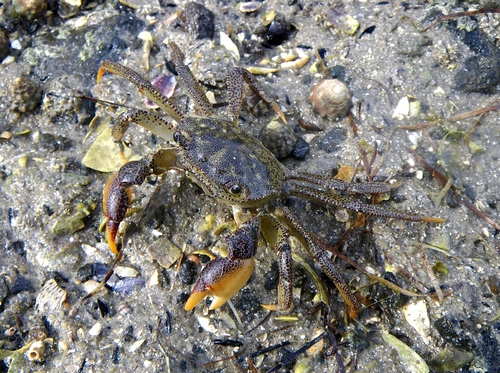
Common Shore Crab
Paragrapsus gaimardii
The resilient 'janitor' of the Australian coast, this mottled crustacean is a master of the intertidal zone. Watch as it emerges from the shadows of the Great Southern Reef to patrol the shoreline.
Quick Identification
Size
Carapace width of 3-6 cm (1.2-2.4 inches); total leg span up to 15 cm (6 inches); weight 20-50g
Colors
Mottled greenish-grey, brown, or dark red; pale cream underside; legs often feature small dark spots
Key Features
- Smooth, square-shaped carapace (shell) with no distinct ridges
- Three small teeth on the side of the shell behind each eye
- Stout, equal-sized claws that are significantly larger in adult males
When You’ll See Them
Geographic range
Where Does the Common Shore Crab Live?
The Common Shore Crab is native to the temperate southern waters of the Australian continent. Its core range spans the southeast coast, stretching from the central waters of New South Wales, around the entire coastlines of Victoria and Tasmania, and extending westward into South Australia. It is a quintessential species of the Great Southern Reef region, thriving in almost every sheltered bay and estuary within its territory.
Basemap © OpenStreetMap contributors
Behavior
The Common Shore Crab is a highly adaptable and active scavenger that dominates the intertidal zones of southern Australia. While they can be seen during the day scuttling between crevices, they are primarily nocturnal, emerging in large numbers as the sun sets to forage across mudflats and rocky reefs. They are famously hardy, capable of surviving significant periods out of water by keeping their gills moist in the humid environments beneath rocks or within burrows.
Socially, these crabs are somewhat territorial but frequently congregate where food is abundant. When threatened, they exhibit a classic defensive posture, raising their claws high to ward off predators like gulls or octopuses. Interestingly, they have a complex relationship with humans; while often overlooked by beachgoers, they are vital 'janitors' of the shoreline, cleaning up organic debris and maintaining the health of estuarine ecosystems.
EverydayEarth exclusive
Camera Tips
Capturing the Common Shore Crab on camera requires a focus on the intertidal 'golden hour'—the time when the tide is receding after dark. To get the best shots, position your camera at a very low angle, just a few inches above the substrate. Use a weighted mini-tripod or a sandbag to ensure the camera remains stable on uneven rocky surfaces or soft mud. Ensure your camera is housed in a high-quality waterproof casing, as salt spray and unexpected waves are constant risks in this environment.
Since these crabs are most active under the cover of darkness, infrared (IR) night vision is essential. Standard white light flashes can cause the crabs to quickly retreat into their burrows or under rocks. Set your camera’s trigger sensitivity to high, as their skittering movements are fast but low-profile. A 'macro' or close-focus setting is highly recommended to capture the intricate mottled patterns on their shells and the fine hairs on their legs.
To attract them to a specific spot for your camera, place a small amount of 'scent bait'—such as a piece of oily fish or a crushed mussel—inside a small mesh bag anchored to a rock. This prevents the crab from simply dragging the food away and keeps them in the frame for longer. If you are setting up near a backyard canal or jetty, try to position the camera near the water line during a falling tide when the crabs are most eager to begin their nightly foraging.
Frequently Asked Questions
Record Common Shore Crab at your habitat
Connect a camera to start building your own species record — AI identifies every visitor automatically.