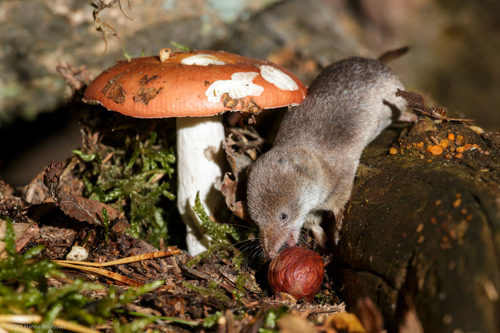
Common Shrew
Sorex araneus
The Common Shrew is a miniature marvel of the undergrowth, a velvet-clad hunter that lives life in the fast lane. Despite their tiny size, these fierce insectivores are the unsung heroes of the garden, working around the clock to keep pest populations in check.
Quick Identification
Size
Body length 55-82 mm (2.2-3.2 in); tail length 32-52 mm (1.3-2.0 in); weight 5-12 g (0.18-0.42 oz)
Colors
Tricolored coat featuring a dark chocolate brown back, pale brown flanks, and a greyish-white underside; teeth have distinct red tips.
Key Features
- Pointed, highly mobile snout with sensitive whiskers
- Small, dark eyes and ears almost entirely hidden by velvety fur
- Distinct tricolored fur pattern (dark back, lighter sides, pale belly)
- Iron-pigmented red-tipped teeth
- Short tail approximately half the length of the body
When You’ll See Them
Geographic range
Where Does the Common Shrew Live?
The Common Shrew is a widespread native of Northern Europe and Northern Asia, stretching from the British Isles across the continent to the Yenisei River in Siberia. While they are one of the most populous mammals in Great Britain, they are notably absent from Ireland, where the Pygmy Shrew takes their place. Their range extends from the northern reaches of Scandinavia down into the mountainous regions of central and southern Europe.
Basemap © OpenStreetMap contributors
Behavior
The Common Shrew is a creature of perpetual motion, driven by an incredibly high metabolic rate that requires it to eat every few hours. This leads to a unique polyphasic activity pattern, where the shrew cycles through bursts of intense foraging and short periods of sleep roughly every three hours, day and night. They are fiercely territorial and solitary animals, only coming together briefly during the breeding season. If two shrews meet, they often engage in loud, high-pitched squeaking matches to defend their patches of leaf litter.
Though they are primarily terrestrial, Common Shrews are surprisingly versatile; they are capable of climbing low-hanging branches and are competent swimmers. They do not hibernate, instead remaining active throughout the winter, though they may shrink their body size—including their internal organs and brain—to conserve energy during lean months. While they have poor eyesight, they navigate their dark, subterranean world using an acute sense of smell and touch, and some evidence suggests they may use a primitive form of echolocation.
EverydayEarth exclusive
Camera Tips
Capturing a Common Shrew on camera is a rewarding challenge due to their small size and lightning-fast movements. To get clear shots, you must place your camera as low to the ground as possible, ideally focusing on 'shrew runs'—the narrow, cleared paths they create under long grass or along the base of stone walls and log piles. Because of their tiny stature, use a camera with a close-focusing lens or a macro setting; otherwise, the animal may appear as a blurry brown smudge.
While shrews won't visit standard bird feeders, you can entice them into a 'photo zone' by placing a small amount of mealworms or wet cat food inside a short section of PVC pipe or under a propped-up tile. This protection prevents larger animals like cats or crows from stealing the bait and forces the shrew to pause long enough for the camera to trigger. Setting your camera to record short, high-frame-rate video clips (60fps or higher) is often more effective than still photos for capturing their rapid, twitchy snout movements.
Since shrews operate on a 24-hour cycle, keep your camera active around the clock. Their low body mass sometimes fails to trigger standard PIR motion sensors, so increase your camera's sensitivity to its highest setting. If your camera supports it, a 'fast-fire' or 'burst' mode will help ensure you catch the animal rather than just its tail as it scurries by. Pay extra attention to your camera after a rainstorm, as the moisture brings earthworms to the surface, sparking a flurry of shrew activity.
Frequently Asked Questions
Record Common Shrew at your habitat
Connect a camera to start building your own species record — AI identifies every visitor automatically.