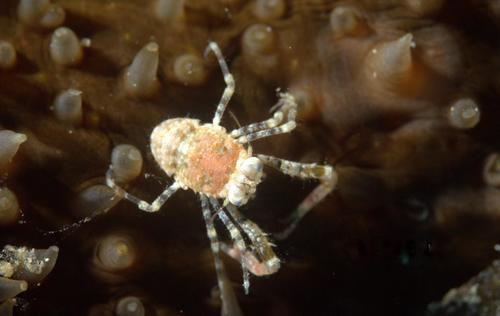
Common Squat Lobster
Iridonida pusilla
A vibrant dweller of the Indo-Pacific depths, the Common Squat Lobster is a master of crevice living and agile underwater maneuvers. Its striking orange shell and spindly claws make it a prize find for deep-sea observers.
Quick Identification
Size
Carapace length 10-18 mm (0.4-0.7 in); total length including claws up to 50 mm (2 in)
Colors
Bright orange to reddish-pink carapace with lighter transverse ridges; claws often have pale tips
Key Features
- Long, slender claws twice the body length
- Flattened body with abdomen tucked underneath
- Large, dark prominent eyes
- Transverse ciliated ridges across the shell
When You’ll See Them
Geographic range
Where Does the Common Squat Lobster Live?
The Common Squat Lobster is primarily native to the Western Pacific Ocean, with a core range centered around the Japanese archipelago and extending southward through the Philippine Sea. It is also frequently documented in the nutrient-rich waters surrounding Indonesia and parts of Northern Australia. This species thrives in the sublittoral zone, favoring the stable, cooler environments of the continental shelf over shallow tidal areas.
Basemap © OpenStreetMap contributors
Behavior
The Common Squat Lobster is a cryptic and largely nocturnal crustacean that lives within the safety of rocky crevices and deep-water coral reefs. Despite their name, they are more closely related to hermit crabs than true lobsters. They are highly agile, capable of rapid backward movement by forcefully flapping their tail fan, a behavior typically used to escape predators like larger fish and octopuses.
In their natural environment, these lobsters are social but competitive, often congregating in areas with high water flow that brings in plentiful organic particles. They spend much of their time 'grooming' the water or the seafloor using specialized feathery appendages near their mouths to filter out food. While they appear aggressive with their long claws, these limbs are primarily used for light scavenging and signaling to other squat lobsters during territorial disputes.
EverydayEarth exclusive
Camera Tips
Capturing the Common Squat Lobster requires specialized underwater imaging equipment, as they reside at depths unreachable by standard waterproof housing. For coastal residents with access to underwater ROVs (Remotely Operated Vehicles) or drop-cameras, the best strategy is to target vertical rock faces or the edges of deep-water reefs where current flow is consistent. These crustaceans are rarely found on open sandy flats, preferring the protection of complex structures.
Lighting is the most critical factor for a successful capture. Squat lobsters are sensitive to bright white light, which often causes them to retreat deep into crevices. Using a camera equipped with red LED or infrared illumination allows you to observe their natural scavenging behavior without startling them. Position the camera at a 45-degree angle to a known crevice entrance, as this provides the best view of their long claws and facial features when they emerge to feed.
If using a stationary baited camera (BRUV), use a high-scent lure like crushed oily fish or shrimp contained within a fine mesh bag. This will draw the lobsters out of hiding and keep them in the camera's field of view for an extended period. Because they are relatively small, ensure your camera is set to a macro or close-focus mode. Given the depth, ensure all seals are meticulously maintained and use a weighted tripod to prevent the camera from being shifted by deep-sea currents.
Frequently Asked Questions
Record Common Squat Lobster at your habitat
Connect a camera to start building your own species record — AI identifies every visitor automatically.