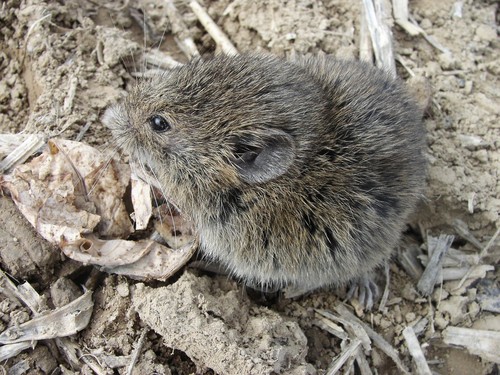
Common Vole
Microtus arvalis
The common vole is a master architect of the undergrowth, creating hidden highways beneath our feet. These energetic herbivores are the pulse of the meadow, active at all hours and fascinating to watch on a ground-level camera.
Quick Identification
Size
Body length 9–12 cm (3.5–4.7 in); tail length 3–4.5 cm (1.2–1.8 in); weight 15–50 g (0.5–1.8 oz).
Colors
Yellowish-grey to brownish-grey upper fur with pale grey to white underparts; tail is bi-colored, darker on top and lighter beneath.
Key Features
- Compact, rounded body with very short legs
- Small, rounded ears almost entirely hidden in fur
- Short tail, roughly one-third the body length
- Blunt, rounded muzzle compared to mice
When You’ll See Them
Geographic range
Where Does the Common Vole Live?
Native to the continent of Europe and parts of Western Asia, the common vole is one of the most widely distributed small mammals in the region. Its core range spans from the Atlantic coast of France and Northern Spain across Central Europe, reaching as far east as the Altai Mountains in Russia. While it is found throughout most of mainland Europe, including Germany, Poland, and the Balkans, it is notably absent from the majority of the British Isles and Fennoscandia, with the exception of the Orkney Islands where a specific subspecies resides.
Basemap © OpenStreetMap contributors
Behavior
The common vole is an incredibly industrious and social rodent, known primarily for its engineering of 'vole runs.' These are complex networks of surface paths and underground tunnels hidden beneath tall grass. They are highly active creatures that alternate between short bursts of foraging and periods of rest every few hours. Unlike many other small mammals that are strictly nocturnal, the common vole is active both day and night, making it a frequent star on backyard cameras.
In a backyard setting, you might notice their presence by small, clean-cut holes in the turf about the size of a golf ball. While they live in colonies and can be quite numerous, they are wary of open spaces where they are vulnerable to predators like owls, kestrels, and foxes. Their social structure is fascinating, with females often sharing communal nests to raise their young during population booms.
EverydayEarth exclusive
Camera Tips
To successfully capture the common vole on a backyard camera, you must think at ground level. These rodents rarely venture into the open, so place your camera no more than 5 to 10 centimeters (2-4 inches) above the ground. The best locations are near 'runs'—the tiny, matted-down paths in long grass—or right next to burrow entrances. Because they are small, ensure your camera has a close focal distance; if it doesn't, try to angle the camera so the vole passes at least 1 meter away to avoid a blurry image.
Voles are creatures of habit and will repeatedly use the same paths. You can encourage them to stop and pose for a photo by placing a 'lure' such as a small pile of birdseed, sliced apples, or rolled oats directly in the path of the lens. This is especially effective in the late afternoon or early morning when they are most active. If you find a burrow entrance, aim the camera at the hole, but be sure to clear away any loose blades of grass that might blow in the wind, as these will cause hundreds of 'false triggers' on your PIR sensor.
Settings are crucial for such a fast-moving subject. Set your camera to its highest sensitivity and use a short trigger interval—ideally under 0.5 seconds. A 10-second video clip is often more rewarding than a photo, as it allows you to observe their frantic grooming and feeding behaviors. In the winter, keep your camera out; voles do not hibernate and are frequently seen scavenging under bird feeders when the snow cover is light.
Similar Species
Species that look similar or are commonly confused with Common Vole.
Bank Vole
The bank vole has a significantly longer tail (half its body length) and more reddish-brown fur compared to the grey-brown common vole.
Field Vole
Also known as the short-tailed vole, it has shaggier fur that almost completely hides its ears, whereas the common vole's ears are clearly visible.
Frequently Asked Questions
Record Common Vole at your habitat
Connect a camera to start building your own species record — AI identifies every visitor automatically.