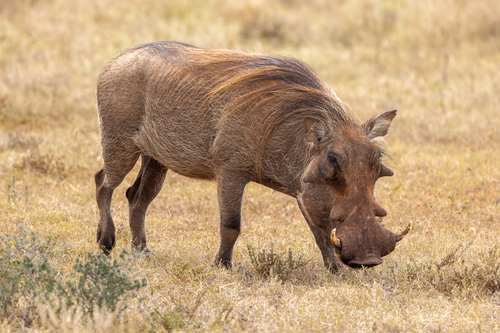
Common Warthog
Phacochoerus africanus
With their iconic tusks and vertical tails, Common Warthogs are the spirited 'architects' of the African savanna. These resilient survivors are famous for their knee-grazing antics and remarkable social bonds.
Quick Identification
Size
Length: 0.9 to 1.5 m (3.0 to 4.9 ft); Weight: 45 to 150 kg (100 to 330 lbs)
Colors
Sparse grey to blackish bristles over slate-grey skin; dark mane along the spine; whitish cheek whiskers
Key Features
- Two pairs of distinct facial warts (larger in males)
- Large, upward-curving ivory tusks
- Runs with tail held vertically like an antenna
- Flat-topped head with a long, powerful snout
When You’ll See Them
Sightings on EverydayEarth
Aug 2, 2026
Two White Rhinoceroses, likely a mother and her calf, are standing in the center of the dusty enclosure, occasionally lowering their heads to explore the ground. In the background near the fence line, a group of warthogs is busy foraging in the dirt, kneeling on their front legs to reach the sparse vegetation and roots.
Aug 2, 2026
Several hippopotamuses are resting in a watering hole, with some mostly submerged and one larger individual partially on a muddy bank. Three Egyptian Geese are perched on a fallen log in the middle of the water. In the background, a common warthog emerges from the brush on the left and walks across the far bank.
Jul 30, 2026
At a busy waterhole in Laikipia, a large pod of hippopotamuses rests in the muddy water, occasionally surfacing to breathe. On the far bank, several warthogs are seen foraging through the dry grass. A Black-headed Heron stands motionless on a fallen log in the middle of the pool, likely waiting for prey, while other water birds are scattered on the surrounding rocks.
Jul 30, 2026
A bustling morning scene at a waterhole features multiple hippos lounging in the water, with one large individual walking along the right bank into the river. On the far grassy bank, a common warthog trots from right to left. Several water birds are present, including an African spoonbill on a log, and a black-headed heron and marabou stork standing on foreground rocks.
Jul 26, 2026
A group of hippopotamuses is seen resting and socializing in a waterhole, with several individuals partially submerged. On the far right bank, a warthog is briefly visible trotting away from the water toward the surrounding brush. A few Egyptian Geese are perched on fallen logs in the center of the waterhole, while others swim nearby.
Jul 24, 2026
A group of White Rhinoceroses are gathered in a dusty enclosure, mostly resting or slowly shifting positions under the shade of trees. In the mid-ground, a Common Warthog walks purposefully across the open area from left to right, holding its tail characteristically upright.
Geographic range
Where Does the Common Warthog Live?
The Common Warthog is a quintessential African species, native to the vast landscapes of sub-Saharan Africa. Their range is extensive, stretching from the semi-arid Sahel region in the north, through the iconic grasslands of East Africa in countries like Kenya and Tanzania, and down into the southern reaches of South Africa and Namibia. While they are absent from the dense, humid rainforests of Central Africa and the most extreme desert environments, they are a common sight across almost every other open habitat on the continent.
Basemap © OpenStreetMap contributors
Recorded on EverydayEarth
Behavior
Common Warthogs are the only pigs adapted for grazing in savanna habitats. They are highly social and usually live in family groups known as 'sounders,' which typically consist of several females and their young. Mature males tend to live solitary lives, only joining sounders during the breeding season. Unlike many other African mammals that remain active at night, warthogs are strictly diurnal, retreating into underground burrows—often stolen from aardvarks—to sleep and avoid nocturnal predators like lions and hyenas.
One of their most endearing and unique behaviors is 'knee-walking.' Because they have relatively short necks and long legs, they have evolved calloused pads on their wrists that allow them to shuffle along on their front knees while grazing or digging for roots. They are also known for their symbiotic relationships; it is not uncommon to see a warthog standing perfectly still while a mongoose or oxpecker grooms its skin to remove ticks and parasites.
EverydayEarth exclusive
Camera Tips
To capture the best footage of Common Warthogs, mounting your camera at a low 'knee-high' angle is essential. Aim for a height of about 12 to 18 inches (30–45 cm) off the ground. This low perspective is perfect for documenting their unique knee-grazing behavior and ensures you get a clear look at their facial features and tusks. Because they are strictly diurnal, you can save battery and storage space by setting your camera to be active only during daylight hours, though dawn and dusk offer the most dramatic lighting for their coarse manes.
Focus your camera placement on high-traffic areas such as well-worn game trails leading to water holes or near active burrows. Warthogs are frequent bathers and love mud wallows to cool down and protect their skin from insects; a camera angled toward a mud hole is almost guaranteed to capture interesting social behavior. If you are in a backyard or ranch setting, look for areas of disturbed soil or 'rooting' patches where they have been digging for tubers. Warthogs are fast and can be skittish, so a camera with a trigger speed of 0.3 seconds or faster is recommended to catch them mid-trot.
During the dry season, warthogs become very predictable as they visit water sources daily. This is the best time to capture high-quality video clips of sounders interacting. If your camera is mounted on a post or a thin tree, ensure it is extremely secure; warthogs are surprisingly strong and often use low-hanging objects as scratching posts, which can easily knock a camera out of alignment. Using a protective security housing or 'bear box' is a wise investment to keep the hardware safe from curious snouts and tusks.
Similar Species
Species that look similar or are commonly confused with Common Warthog.
Frequently Asked Questions
Record Common Warthog at your habitat
Connect a camera to start building your own species record — AI identifies every visitor automatically.