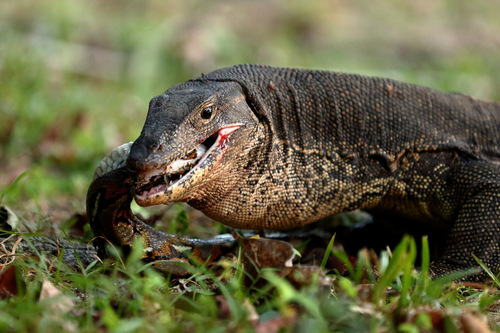
Common Water Monitor
Varanus salvator
The Common Water Monitor is the world's second-largest lizard and a master of the Asian wetlands. Intelligent, adaptable, and a champion swimmer, this 'modern-day dinosaur' is as comfortable in a backyard pond as it is in a tropical mangrove.
Quick Identification
Size
Typically 1.5–2 meters (5–6.6 feet) in length; weights range from 15–25 kg (33–55 lbs), though exceptional males can reach 3 meters and over 50 kg.
Colors
Dark brown or black base color with yellow ocelli (eye-like spots) or bands; pale cream or yellow belly; dark stripes behind the eyes.
Key Features
- Laterally compressed tail for powerful swimming
- Long, deeply forked blue tongue
- Nostrils located near the tip of the snout
- Sharp, curved claws and powerful limbs
When You’ll See Them
Geographic range
Where Does the Common Water Monitor Live?
Native to the tropical regions of South and Southeast Asia, the Common Water Monitor has one of the widest distributions of any monitor lizard. Its core range spans from eastern India and Sri Lanka through the Indochinese peninsula and southern China, extending across the Malay Peninsula to the islands of Indonesia and the Philippines. Because they are excellent swimmers, they have successfully colonized numerous small island chains throughout the Indian and Pacific Oceans.
Basemap © OpenStreetMap contributors
Behavior
The Common Water Monitor is a highly intelligent and opportunistic reptile, often found near water sources ranging from remote mangroves to urban drainage systems. They are diurnal, spending their mornings basking in the sun to regulate their body temperature before beginning their daily search for food. While they are primary solitary, they can be found in high densities where food is abundant, such as near fish markets or city parks, where they show a remarkable tolerance for human presence.
As semi-aquatic animals, they are master swimmers and can remain submerged for up to 30 minutes. On land, they are surprisingly agile, capable of running quickly and climbing trees to raid bird nests or escape larger predators. Their tongue-flicking behavior is a key part of their sensory world, as they use their vomeronasal organ to 'taste' the air for chemical cues of prey or rivals from a great distance.
EverydayEarth exclusive
Camera Tips
To capture these impressive reptiles on camera, placement is everything. Position your device 30 to 60 centimeters (1 to 2 feet) above the ground, as monitors are low-slung and you want to capture their full profile rather than just their back. Focus your lens on 'highway' zones like the muddy edges of ponds, gaps in garden fences, or drainage pipes, which they frequently use as corridors. Look for signs of their presence like claw marks or the distinct 'tail-drag' line in soft sand or mud.
Monitors are driven by their sense of smell, making them one of the easiest reptiles to lure. A small mesh container with raw fish or meat scraps will keep them occupied in front of the camera for several minutes, providing excellent footage of their powerful jaws and forked tongue in action. If you prefer not to use bait, look for sun-drenched flat rocks or fallen logs near water; these are preferred basking spots where the lizards will remain stationary for long periods during the mid-morning.
Because they are most active during the brightest part of the day, configure your camera to handle high-contrast light. Avoid pointing the lens directly toward the sun to prevent 'white-out.' If your camera has a video mode, set it to record 30-second clips. Still photos often fail to capture the lizard's serpentine movement and the sheer scale of their bodies, whereas video truly showcases their prehistoric elegance and power.
Similar Species
Species that look similar or are commonly confused with Common Water Monitor.
Frequently Asked Questions
Record Common Water Monitor at your habitat
Connect a camera to start building your own species record — AI identifies every visitor automatically.