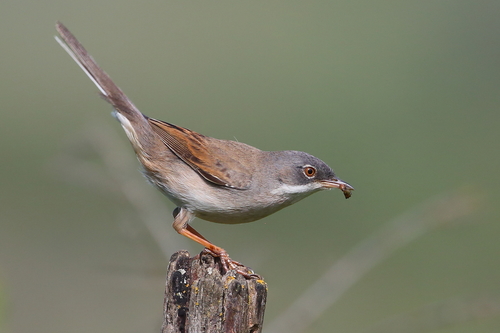
Common Whitethroat
Curruca communis
With its brilliant white throat and energetic song flights, the Common Whitethroat is the quintessential sound of a thriving summer hedgerow. This tireless traveler bridges the gap between European countrysides and the African savanna every year.
Quick Identification
Size
Length 14 cm (5.5 in), wingspan 18.5–23 cm (7.3–9 in), weight 12–18 g (0.4–0.6 oz)
Colors
Rich grey-brown back, contrasting bright white throat, and distinctive chestnut-edged wing feathers. Males feature a soft grey head and pinkish flush on the breast; females have a brown head and buff underparts.
Key Features
- Bright white throat patch contrasting with darker head
- Chestnut-brown edges on wing feathers
- Long, white-edged tail often flicked or fanned
- Male has a distinctive grey head and rosy breast
When You’ll See Them
Geographic range
Where Does the Common Whitethroat Live?
Native to the Palearctic region, the Common Whitethroat breeds across nearly all of Europe, from the British Isles and Scandinavia down to the Mediterranean, and extends eastward through Turkey into Central Asia and Siberia. As a long-distance migrant, it vacates these northern lands in late summer to spend the winter in the tropical savannas and scrublands of sub-Saharan Africa, as well as parts of the Arabian Peninsula and Pakistan. While it is a common sight in rural landscapes across its native range, its population is highly sensitive to rainfall levels in its African wintering grounds.
Basemap © OpenStreetMap contributors
Behavior
The Common Whitethroat is a lively and restless warbler, often seen darting through dense hedgerows and scrubby vegetation. During the breeding season, males are famous for their jerky 'song flights,' where they fly up from a perch while singing a scratchy, hurried tune before diving back into cover. They are somewhat secretive when feeding but become highly visible when defending territory.
These birds are highly migratory, arriving in Europe and Western Asia during the spring to breed and heading back to sub-Saharan Africa for the winter. While they are primarily solitary during the breeding season, they may gather in small groups at coastal sites before migration. In garden settings, they are less likely to visit feeders than tits or finches, preferring to stay within the safety of thick brambles or shrubs.
EverydayEarth exclusive
Camera Tips
Capturing the Common Whitethroat on camera requires a strategy focused on their love for dense cover. Position your AI-powered camera near thick hedgerows, bramble patches, or 'wild' corners of the garden where scrubby vegetation is at least chest-high. Since they rarely feed on the ground or at traditional bird tables, aim the camera at a prominent 'song post'—a protruding branch or the top of a bush where males frequently perch to sing.
A water feature is your best bet for a close-up. A shallow, trickling bird bath placed near cover is irresistible to Whitethroats, especially during hot summer days or during the peak migration months of May and August. Set the camera at a slight downward angle about 3 to 5 feet away from the water source to ensure the white throat and chestnut wing markings are clearly visible for the AI identification system.
Lighting is crucial for this species; their subtle grey and brown tones can wash out in harsh midday sun. East-facing setups that catch the soft morning light are ideal, as this is when the birds are most active and vocal. If you are using a trail camera, use a fast shutter speed or high-frame-rate video setting to catch their quick, nervous movements and characteristic tail-flicking behavior.
Similar Species
Species that look similar or are commonly confused with Common Whitethroat.
Frequently Asked Questions
Record Common Whitethroat at your habitat
Connect a camera to start building your own species record — AI identifies every visitor automatically.