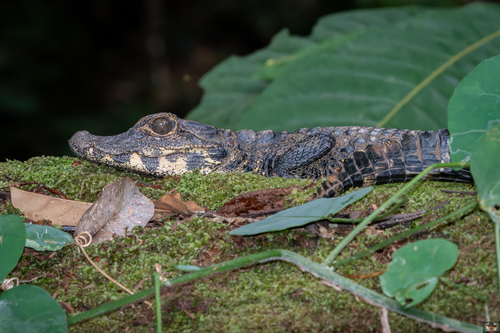
Congo Dwarf Crocodile
Osteolaemus osborni
Meet the world's smallest crocodile, a shy 'living fossil' that prowls the flooded forests of the Congo Basin by night.
Quick Identification
Size
1.2 to 1.5 metres (3.9 to 4.9 feet) in length; weighs between 15 and 35 kg (33 to 77 lbs)
Colors
Dark brownish-black body with a yellowish underside featuring heavy black blotching; juveniles show lighter brown or yellow cross-banding
Key Features
- Short, blunt snout with an upturned profile
- Extremely heavy bony armor (osteoderms) covering the neck and back
- Smallest living species of crocodilian
- Dark, almost charcoal-colored scales
- Eyes set high on the head for surface swimming
When You’ll See Them
Geographic range
Where Does the Congo Dwarf Crocodile Live?
Native to the dense, humid heart of Central Africa, the Congo Dwarf Crocodile is a specialist of the Congo River basin. Its core range is concentrated within the Democratic Republic of the Congo, extending into parts of the Republic of the Congo, the Central African Republic, and northeastern Angola. Unlike many other crocodilians that require vast open waterways, this species thrives in the shaded, narrow tributaries and flooded interior forests of the African tropics.
Basemap © OpenStreetMap contributors
Behavior
The Congo Dwarf Crocodile is a secretive and primarily nocturnal reptile, spending its days hidden in burrows or submerged under tree roots along riverbanks. Unlike many of its larger cousins, this species is surprisingly terrestrial at night, often wandering deep into the forest floor under the cover of darkness to hunt for prey far from the water's edge.
Socially, they are largely solitary and shy, quickly retreating into the water or into a hole if they sense human presence. While they lack the aggressive reputation of the Nile Crocodile, they are fiercely protective of their nests; females construct mound-shaped nests of decaying vegetation and stay nearby to guard the eggs and assist the hatchlings once they emerge.
EverydayEarth exclusive
Camera Tips
To capture the Congo Dwarf Crocodile on camera, focus on 'choke points' along muddy riverbanks or near submerged logs where they exit the water. Because they are cold-blooded, traditional PIR (Passive Infrared) sensors can struggle to trigger if the crocodile's body temperature matches the ambient air. Using a camera with a high-sensitivity sensor or setting your device to a fast time-lapse mode during the night can significantly increase your success rate.
Placement is crucial: set your camera low to the ground, no more than 12 to 18 inches high, aimed parallel to the water's edge. This species often follows the same 'trails' through the mud when moving between water and forest. Look for belly slides or claw marks in the mud to find these high-traffic areas. Since they are strictly nocturnal, ensure your camera has a high-quality, 'no-glow' infrared flash to avoid spooking them, as they are notoriously shy and sensitive to light.
While baiting is generally discouraged in wildlife photography, some researchers use fresh fish or oily meat placed in a secure, perforated container near the camera to draw them into the frame. However, the best results often come from patience during the dry season when water levels drop, forcing the crocodiles into smaller, more predictable pools of water where activity is concentrated.
Similar Species
Species that look similar or are commonly confused with Congo Dwarf Crocodile.
Frequently Asked Questions
Record Congo Dwarf Crocodile at your habitat
Connect a camera to start building your own species record — AI identifies every visitor automatically.