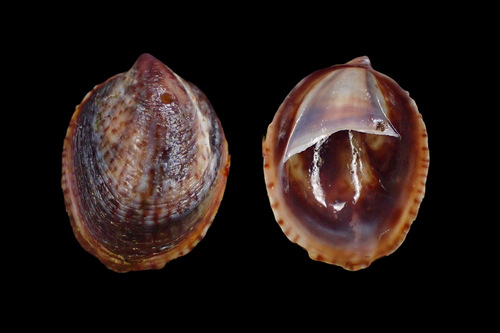
Convex Slippersnail
Crepidula convexa
Meet the tiny hitchhiker of the shoreline. The Convex Slippersnail is a master of camouflage and coastal adaptation, known for its distinctively high-domed shell and fascinating life at the water's edge.
Quick Identification
Size
10–20 mm (0.4–0.8 inches) in length
Colors
Typically reddish-brown, dark brown, or tan; often features dark specks or mottled patterns on the shell
Key Features
- Distinctively high-domed or convex shell shape
- Internal horizontal shelf (septum) covering nearly half the shell opening
- Small size, rarely exceeding 2 centimeters
- Often found attached to the shells of hermit crabs or other mollusks
When You’ll See Them
Geographic range
Where Does the Convex Slippersnail Live?
This species is native to the Atlantic coast of North America, stretching from the cold waters of the Gulf of St. Lawrence in Canada down to the warmer shores of Florida and the Gulf of Mexico. Within this core range, it is a common inhabitant of estuaries and protected bays. It has also been successfully introduced to parts of the Pacific coast, including Washington and California, where it has established localized populations in several coastal inlets.
Basemap © OpenStreetMap contributors
Behavior
The Convex Slippersnail is a sedentary marine gastropod known for its unique 'hitchhiking' lifestyle. Unlike many snails that roam freely, these mollusks often spend their adult lives attached to a single spot, frequently choosing the shells of hermit crabs, horseshoe crabs, or larger gastropods as their substrate. This allows them to benefit from the movement of their host, which brings them into contact with new water sources for filter feeding.
Interestingly, this species is a protandrous hermaphrodite, meaning individuals typically begin their lives as males and later transition into females as they grow larger. They are social creatures in a sense, often found in small clusters where the larger females are situated at the bottom and smaller males are positioned on top. They do not interact with humans directly, but they are a vital part of the coastal ecosystem, serving as both a food source for larger predators and a competitor for space in crowded intertidal zones.
EverydayEarth exclusive
Camera Tips
Capturing a Convex Slippersnail requires a specialized approach, as these marine mollusks are both small and relatively sedentary. To get high-quality footage or photos, you will need an underwater-capable camera or a waterproof housing for your trail camera. Position the camera during low tide in a protected tide pool or near pier pilings where you can see clusters of shells. A macro lens or a close-up filter is essential to reveal the detail of their high-domed shells and the delicate markings that distinguish them from other related species.
Because these snails move very slowly, traditional motion-trigger settings often fail to capture their behavior. Instead, use a 'time-lapse' or 'interval' mode, setting the camera to take a photo every 5 to 10 minutes. This will allow you to see their subtle movements and filter-feeding activity as the tide rises and falls. If you are placing your camera on a mudflat, ensure it is weighted or secured to a stake to prevent it from drifting with the current or being buried by shifting sediments.
Lighting is another crucial factor for underwater backyard photography. While natural light works well in shallow water during the day, using an external waterproof LED light can help illuminate the dark crevices under rocks or inside shells where these snails often hide. If you're hoping to see them on the move, try to time your camera checks around the lunar cycle; they are most active when the incoming tide brings a fresh supply of plankton-rich water for them to filter. Remember to clean the camera lens frequently, as salt spray and algae can quickly obscure your view in marine environments.
Frequently Asked Questions
Record Convex Slippersnail at your habitat
Connect a camera to start building your own species record — AI identifies every visitor automatically.