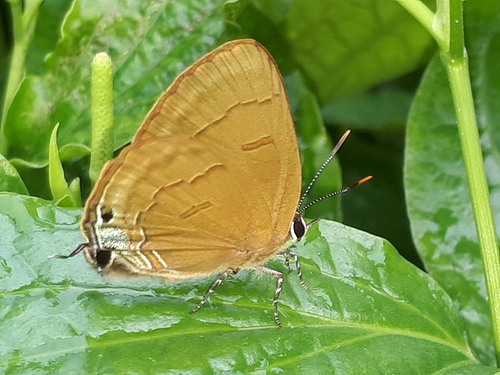
Copper Flash
Rapala pheretima
A shimmering jewel of the tropical garden, the Copper Flash is known for its metallic orange glow and high-speed aerial acrobatics. This resilient butterfly is a master of disguise, blending into the shadows until it catches a beam of sunlight.
Quick Identification
Size
Wingspan of 35-42 mm (1.4-1.65 inches)
Colors
Males feature a brilliant metallic coppery-red upperside with dark brown borders; females are duller brown. Both sexes have greyish-brown undersides with dark transverse bands and orange-rimmed black spots near the tail.
Key Features
- Brilliant metallic copper upperside (males)
- Delicate hair-like tails on the hindwings
- Orange and black 'false eyes' on the underside tornus
- Fast, erratic flight pattern
When You’ll See Them
Geographic range
Where Does the Copper Flash Live?
The Copper Flash is native to the Indomalayan realm, thriving across much of South and Southeast Asia. Its core range includes India, Myanmar, Thailand, Malaysia, Singapore, and Indonesia, extending into the Philippines. It is a common sight in these regions wherever tropical vegetation and suitable host plants are found.
Basemap © OpenStreetMap contributors
Behavior
The Copper Flash is a highly active and territorial butterfly. Males are often seen perching on the tips of leaves in prominent, sun-drenched spots, where they keep a watchful eye over their territory. If an intruder—whether another butterfly or a similar-sized insect—enters their airspace, they will launch into a rapid, zig-zagging pursuit before returning to the exact same perch.
Unlike some forest-dwelling butterflies, the Copper Flash is quite comfortable in human-altered landscapes. They are frequent visitors to garden flowers and are often seen 'mud-puddling' on damp soil or gravel paths to intake essential salts and minerals. Because of their speed, they can be difficult to observe closely until they settle down to feed on nectar or rest in the late afternoon sun.
EverydayEarth exclusive
Camera Tips
To capture the Copper Flash, your best bet is to focus your camera on nectar-rich flowering shrubs like Lantana, Ixora, or Poinsettia. Because these butterflies move incredibly fast, a traditional motion-trigger might be too slow; instead, use a high-speed 'trap' setting or a time-lapse mode that takes a photo every 2 to 5 seconds during the peak sun hours of 10 AM to 2 PM.
Male Copper Flashes are creatures of habit. If you see one perching on a specific leaf at the edge of a sunny clearing, there is a very high probability it will return to that same spot repeatedly. Position your camera on a tripod or mount, pre-focused on that leaf, to capture the stunning metallic upperside of the wings that is only visible when they are basking.
If you are using a trail camera, ensure it has a 'macro' or close-focus capability, as these butterflies are small. Positioning the camera 12-24 inches from a flower cluster is ideal. For the best color reproduction of their copper 'flash,' try to angle the camera so the sun is behind you, illuminating the butterfly's wings directly.
Similar Species
Species that look similar or are commonly confused with Copper Flash.
Frequently Asked Questions
Record Copper Flash at your habitat
Connect a camera to start building your own species record — AI identifies every visitor automatically.