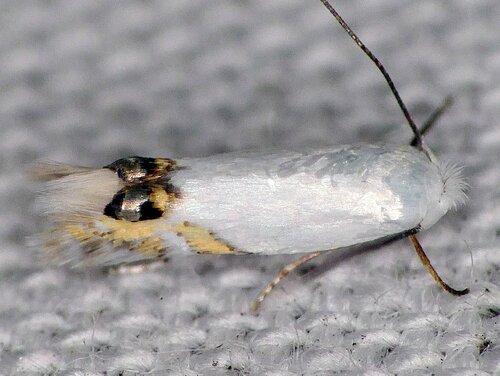
Cottonwood Leafminer
Paraleucoptera albella
A tiny ghost of the Cottonwood canopy, this moth transforms leaves into intricate nurseries. Known for its brilliant silvery wings and unique 'mining' behavior, it is a fascinating example of backyard biodiversity.
Quick Identification
Size
Wingspan of 6–8 mm (0.24–0.31 inches); larvae reach approximately 5 mm (0.2 inches) in length.
Colors
Adults are brilliant silvery-white with small, distinct black and yellow-orange 'eye-spots' on the tips of the forewings. Larvae are pale yellowish-green.
Key Features
- Tiny, brilliant white wings with metallic apical markings
- Larvae create distinct brown, blister-like 'blotch' mines on leaves
- Silky white cocoons often found suspended by threads on bark
- Host-specific to Populus species like Cottonwoods and Aspens
When You’ll See Them
Geographic range
Where Does the Cottonwood Leafminer Live?
Native to the North American continent, the Cottonwood Leafminer is found across a sprawling territory from the southern reaches of Canada through almost the entirety of the United States. It is particularly common in the Great Plains and the Rocky Mountain regions where its host trees follow river systems, and it has successfully adapted to residential areas where Poplars are planted for shade.
Basemap © OpenStreetMap contributors
Behavior
The Cottonwood Leafminer is a master of internal architecture. In its larval stage, this tiny caterpillar lives entirely between the upper and lower layers of a leaf, feeding on the soft tissue inside. This creates a visible 'mine'—a brown or blackened patch that expands as the insect grows. While these blotches might look like a disease to the untrained eye, they are actually the protective nurseries for the next generation of moths.
As adults, these moths are incredibly short-lived and focus almost entirely on reproduction. They are most active during the twilight hours, fluttering around the canopy of Cottonwood trees. When it comes time to pupate, the larvae emerge from their leaf mines and spin unique, H-shaped silken cocoons on the undersides of leaves or in the crevices of the tree's bark, awaiting their transformation into the silvery-white adults.
EverydayEarth exclusive
Camera Tips
Capturing the Cottonwood Leafminer requires a specialized approach because of their diminutive size. Standard trail cameras will likely miss them, so if you are using an AI-powered system, ensure it is set to a high-sensitivity 'Macro' or 'Small Subject' mode. Position your camera just inches away from the leaves of a Cottonwood tree, focusing specifically on the undersides where adults tend to rest during the day.
To document their fascinating life cycle, use a time-lapse setting. By focusing your lens on a healthy leaf in late spring and taking a photo every few hours, you can create a stunning visual record of the 'mine' growing and changing color as the larva feeds inside. This is often more rewarding than trying to catch the moth in flight, as the larvae are much more stationary subjects.
If you want to capture the adult moths, they are highly attracted to light. Setting up a 'moth sheet' with a UV light in your backyard will draw them in. Place your camera on a tripod and use a fast shutter speed; the brilliant white scales of these moths reflect a lot of light, and they can easily appear as a white blur in low-light conditions if the camera isn't stabilized and the exposure isn't correctly managed.
Similar Species
Species that look similar or are commonly confused with Cottonwood Leafminer.
Frequently Asked Questions
Record Cottonwood Leafminer at your habitat
Connect a camera to start building your own species record — AI identifies every visitor automatically.