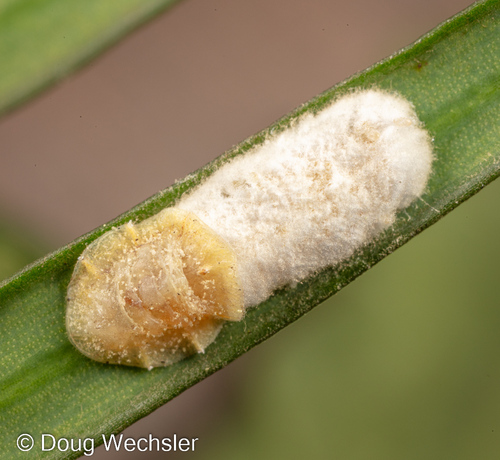
Cottony Camellia Scale
Pulvinaria camelicola
A master of disguise in the garden, the Cottony Camellia Scale is best known for the long, white waxy 'tails' it leaves on the underside of leaves. While often viewed as a pest, its life cycle and symbiotic relationship with ants offer a fascinating glimpse into the complexity of backyard ecosystems.
Quick Identification
Size
Adult females are 3–5 mm (0.1–0.2 in) long; white egg sacs can reach 10 mm (0.4 in)
Colors
Tan to light brown oval bodies with a distinctive, elongated white waxy egg sac
Key Features
- Flat, oval brownish body
- Long, white, ribbed waxy egg sac (ovisac)
- Commonly found on the underside of leaves
- Sticky honeydew residue on foliage
When You’ll See Them
Geographic range
Where Does the Cottony Camellia Scale Live?
Native to Eastern Asia, particularly China and Japan, the Cottony Camellia Scale has successfully traveled the globe via the ornamental plant trade. It is now a common resident throughout the United States, especially in the Southeast and the Pacific Northwest, as well as across much of Western Europe and parts of Oceania. Where Does the Cottony Camellia Scale Live? It thrives wherever its favorite host plants—Camellias and Hollies—are used in residential and commercial landscaping.
Basemap © OpenStreetMap contributors
Behavior
Cottony Camellia Scales are specialized sap-sucking insects that spend the majority of their life cycle attached to the underside of evergreen leaves. As "soft scales," they protect themselves with a thin, waxy coating rather than a hard shell. They are most notable for the female's production of a long, white, cottony ovisac in late spring, which can contain hundreds of eggs. This waxy structure is often much larger than the insect itself, making it easy to spot against dark green foliage.
These insects are largely sessile, meaning they stay in one spot once they find a suitable feeding site. They use needle-like mouthparts to pierce plant tissue and drink nutrient-rich sap. A byproduct of this diet is the excretion of 'honeydew,' a sugary liquid that coats nearby leaves. This sticky substance often attracts ants, who protect the scales from predators, and serves as a substrate for black sooty mold, which can eventually cover the plant's surface.
EverydayEarth exclusive
Camera Tips
To capture high-quality images of Cottony Camellia Scale, you will need to utilize a macro lens or a camera with a dedicated 'macro' mode. Because these insects are stationary and quite small, focusing is the biggest challenge. Position your camera on a tripod and aim it at the underside of leaves on a Camellia or Holly bush. Look for the bright white 'cotton' sacs, which provide excellent contrast against the green leaf, but be careful with your exposure; the white wax can easily become overexposed in direct sunlight.
Since these insects don't move, they are the perfect subjects for a multi-day time-lapse. Set your camera to trigger every few hours throughout the month of May or June. This allows you to witness the fascinating process of the female producing the waxy ovisac and the eventual emergence of the tiny, mobile 'crawlers.' Ensure your camera is protected from the wind, as even a light breeze can move the leaf out of the narrow macro focal plane.
If you are using an AI-powered trail camera, place it near a cluster of scales to observe the insect interactions. You will often see ants 'tending' the scales, tapping them with their antennae to stimulate the release of honeydew. You might also catch sight of ladybugs or lacewing larvae, which are natural predators of the scale. Use a side-lighting setup with a small LED panel to highlight the ribbed texture of the ovisac, which adds depth and professional quality to your backyard wildlife photography.
Similar Species
Species that look similar or are commonly confused with Cottony Camellia Scale.
Frequently Asked Questions
Record Cottony Camellia Scale at your habitat
Connect a camera to start building your own species record — AI identifies every visitor automatically.