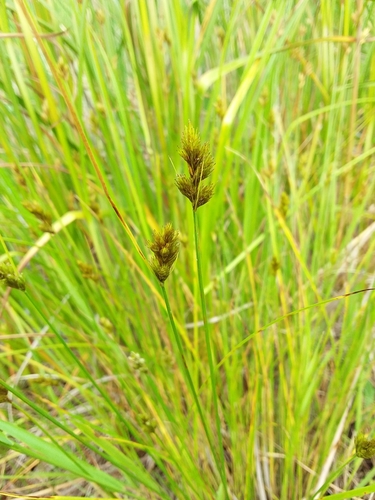
Crawford's sedge
Carex crawfordii
A resilient and tufted pioneer of northern wetlands, Crawford’s sedge is easily recognized by its narrow, pointed golden spikes. It is a vital structural plant that turns damp ditches and meadow edges into thriving miniature ecosystems.
Quick Identification
Size
Stems reach 20–60 cm (8–24 inches) in height; leaves are typically 2–3 mm wide.
Colors
Bright green foliage; flower spikes transition from green to a distinct straw-brown or golden-bronze when mature.
Key Features
- Densely tufted (cespitose) growth habit
- Inflorescence of 3–15 crowded, erect, and pointed spikes
- Extremely narrow, lanceolate perigynia less than 1mm wide
- Wing-margined seeds with a distinctive pointed tip
When You’ll See Them
Geographic range
Where Does the Crawford's sedge Live?
Crawford’s sedge is native to the northern latitudes of North America, with a broad distribution that spans from Newfoundland and Labrador across the Canadian provinces to British Columbia. In the United States, its core range includes the Great Lakes region, New England, and the Pacific Northwest, occasionally dipping further south along cool, high-elevation mountain corridors. It thrives in temperate and boreal zones where moisture is consistent throughout the growing season.
Basemap © OpenStreetMap contributors
Behavior
Crawford's sedge is a hardy, perennial graminoid that plays a vital role in stabilizing soil in moist, disturbed environments. Unlike many plants that struggle in compacted or altered soils, this species often colonizes roadside ditches, recently cleared forest edges, and the margins of receding wetlands. It grows in dense, tight clumps known as tussocks, which provide essential micro-habitats for ground-dwelling insects and small amphibians.
As a wind-pollinated species, it doesn't rely on showy flowers to attract insects, but its seed production is prolific. During the late summer, the seed heads become heavy and provide a foraging resource for small granivorous birds. In a backyard or wild setting, it acts as a structural foundation for the ecosystem, offering cover and moisture retention for the soil surface.
EverydayEarth exclusive
Camera Tips
Capturing Crawford’s sedge on a backyard camera requires a focus on detail and positioning. Because sedges are often identified by the minute structure of their seed heads (perigynia), place your camera in macro or close-up mode if possible. Set the camera on a low tripod or a ground mount, roughly 12 inches from the seed spikes, to capture the sharp, lance-like texture of the inflorescence against a soft background.
To see the "wildlife" aspect of this plant, aim your camera at a cluster of Crawford's sedge near a water source. Many trail cameras are triggered by the movement of small birds like sparrows or finches that visit the plant to eat the seeds in late summer. For the best visual results, position the camera so the morning sun backlights the spikes; this creates a glowing effect on the straw-colored seeds and helps them stand out against darker foliage.
If you are using an AI-powered camera to identify plant species, ensure you have a clear shot of where the stem meets the ground and a high-resolution image of the spikes. Use a 'Time-Lapse' setting during the months of June and July to record the fascinating transition of the flower heads from fresh green to their signature golden-brown bronze. This not only helps with identification but provides a beautiful record of the seasonal rhythm of your local ecosystem.
Frequently Asked Questions
Record Crawford's sedge at your habitat
Connect a camera to start building your own species record — AI identifies every visitor automatically.