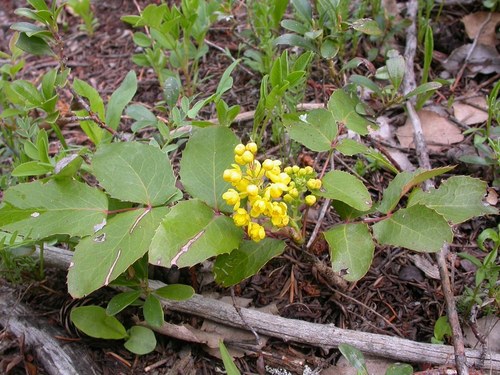
creeping mahonia
Berberis repens
A hardy survivor of the western woods, creeping mahonia blankets the ground with holly-like leaves and vibrant yellow blooms. This versatile evergreen is a favorite 'grocery store' for backyard wildlife, providing berries for birds and winter browse for deer.
Quick Identification
Size
Height: 10–30 cm (4–12 inches); spread is indefinite via underground rhizomes.
Colors
Matte bluish-green foliage that turns bronze or reddish-purple in winter; bright yellow flower clusters; waxy dark blue berries.
Key Features
- Low-growing, mat-forming evergreen habit
- Holly-like leathery leaves with 3-7 oval leaflets
- Dense, rounded clusters of fragrant yellow flowers
- Waxy, dark purple berries that resemble small grapes
When You’ll See Them
Geographic range
Where Does the creeping mahonia Live?
Creeping mahonia is a signature species of Western North America, stretching from the mountainous regions of British Columbia and Alberta down through the Pacific Northwest and the Great Basin. Its native range extends deep into the Rocky Mountain states, reaching as far south as New Mexico, Arizona, and even parts of Texas. While it is a staple of wild pine and fir understories, it has also been widely introduced to suburban landscapes across the United States as a drought-tolerant ornamental plant.
Basemap © OpenStreetMap contributors
Behavior
Creeping mahonia is a resilient, low-growing evergreen shrub that spreads slowly across the forest floor using underground stems called rhizomes. Unlike its taller relatives, this species stays close to the ground, often forming thick, protective mats. This growth habit makes it exceptionally well-adapted to surviving wildfires, as its underground system can quickly sprout new growth even after the surface foliage has been scorched. It is a slow-growing but incredibly hardy plant that provides year-round visual interest as its leaves transition from summer greens to deep, wine-red hues in the winter.
Ecologically, the plant acts as a vital bridge for local wildlife throughout the seasons. In the early spring, its nectar-rich yellow blooms are among the first food sources available for emerging bees and butterflies. By late summer, the plant produces tart, edible berries that are a favorite of songbirds and small mammals. Because it retains its leaves through the snow, it serves as a critical 'emergency' food source for deer and elk during harsh winters when other forage is buried or dormant.
EverydayEarth exclusive
Camera Tips
Because creeping mahonia is a low-growing groundcover, capturing the wildlife it attracts requires a 'critter-eye' perspective. Mount your camera just 6 to 12 inches off the ground, angled slightly upward. This positioning is perfect for catching songbirds like towhees and robins as they forage for berries in late summer, or small mammals like chipmunks that use the dense foliage for cover. If you are targeting deer or elk that browse the leaves in winter, place the camera 3 to 4 feet high on a nearby tree, pointing down toward a healthy patch of the shrub.
To capture the plant's seasonal transformation, use a time-lapse setting. A single photo taken every day at noon can create a stunning video of the flowers blooming in spring or the leaves turning from green to burgundy in late autumn. If your camera has a macro or close-focus mode, position it within two feet of the flower clusters in April or May to record the diverse array of native bees and butterflies that visit the nectar-rich blooms during the heat of the day.
During the winter months, creeping mahonia becomes a 'hotspot' for activity when snow covers other food sources. If you have a trail camera with a high-quality night vision or 'no-glow' flash, keep it active over these plants to record nocturnal visitors like rabbits or even wary predators like foxes that hunt the small rodents attracted to the berries. Make sure to clear away any tall blades of grass immediately in front of the lens, as they can cause overexposure during night shots or trigger the sensor unnecessarily on windy days.
Similar Species
Species that look similar or are commonly confused with creeping mahonia.
Frequently Asked Questions
Record creeping mahonia at your habitat
Connect a camera to start building your own species record — AI identifies every visitor automatically.