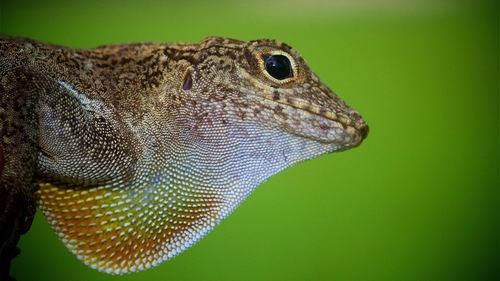
Crested Anole
Anolis cristatellus
Meet the bold, crown-tailed gymnast of the Caribbean. The Crested Anole is a charismatic lizard that brings tropical energy to every tree trunk and garden fence it claims as its own.
Quick Identification
Size
5 to 7.5 inches (12.5 to 19 cm) in total length; weight approximately 3 to 7 grams.
Colors
Varying shades of brown, gray, and tan with dark mottling; males feature a yellow or orange dewlap often bordered in gray or green.
Key Features
- High, fin-like crest along the top of the tail (prominent in males)
- Extendable colorful dewlap under the chin
- Large toe pads for climbing vertical surfaces
- Slender body with a slightly flattened head
When You’ll See Them
Geographic range
Where Does the Crested Anole Live?
Native to the Caribbean, the Crested Anole is primarily found throughout Puerto Rico and the U.S. and British Virgin Islands. Over time, this hardy species has expanded its footprint through human-mediated introduction, establishing flourishing populations in southern Florida, the Dominican Republic, and parts of Costa Rica. Whether in its native tropical forest or a suburban Florida backyard, this anole thrives wherever there are vertical surfaces and plenty of sun.
Basemap © OpenStreetMap contributors
Behavior
The Crested Anole is a highly territorial and visible reptile known for its bold social displays. Males spend much of their day perched on tree trunks or man-made structures, surveying their territory for rivals or potential mates. When a challenger appears, they engage in a ritualistic performance involving rhythmic push-ups and the inflation of their brightly colored dewlap to appear larger and more intimidating. Unlike some shy lizard species, the Crested Anole is remarkably tolerant of human activity, often living in close proximity to homes and gardens.
These lizards are primarily 'trunk-ground' specialists, meaning they spend most of their time on the lower sections of trees but frequently venture onto the ground to hunt or move between perches. They are sit-and-wait predators, remaining perfectly still until they spot a moving insect, at which point they strike with surprising speed. At night, they seek shelter in high foliage or crevices to avoid nocturnal predators like snakes or owls.
EverydayEarth exclusive
Camera Tips
Capturing the Crested Anole on camera requires a strategy tailored to their small size and vertical lifestyle. Start by mounting your camera on a tree trunk or a fence post—their favorite lookout spots—approximately 3 to 5 feet off the ground. Angle the lens slightly downward to cover both the trunk and the immediate ground area, as these lizards frequently jump down to catch prey. Because of their small heat signature, standard PIR (Passive Infrared) sensors can struggle; if your camera allows it, use the 'High Sensitivity' setting or a 'Time Lapse' mode with short intervals to ensure you do not miss them.
Lighting is the most critical factor for a clear shot. These lizards are heliothermic, meaning they use the sun to regulate their body temperature. Position your camera toward a patch of the trunk that receives dappled sunlight during the late morning or early afternoon. This is when they are most likely to be basking and performing their iconic dewlap displays. To get a close-up without blurring, check your camera’s minimum focal distance; if necessary, use a macro lens attachment or mount the camera at least 2-3 feet away to keep the lizard in sharp focus.
While they are not attracted to traditional bait, you can encourage them to hang out in front of your lens by creating a lizard-friendly zone. A small, shallow water dish placed near the base of the tree can be a draw, or even better, plant flowering shrubs nearby that attract the small insects they hunt. During the breeding season, focus on areas where multiple males might be visible, as you are more likely to capture high-energy territorial displays like push-ups and head-bobbing.
Similar Species
Species that look similar or are commonly confused with Crested Anole.
Frequently Asked Questions
Record Crested Anole at your habitat
Connect a camera to start building your own species record — AI identifies every visitor automatically.